

Learning from the past: A How-To For Ending Fossil Fuels
A review of Kevin A. Young's Abolishing Fossil Fuels: Lessons from Movements That Won

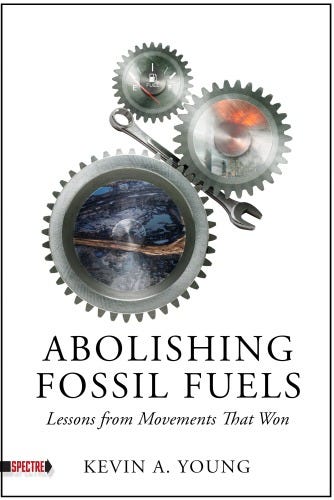
Some political struggles seem so gargantuan that it’s hard to imagine winning at all, let alone crafting a strategy for how to do it. Climate change is perhaps the most emblematic example of all. It’s a global phenomenon caused by the burning of fossil fuels at scales that can make individuals feel utterly powerless. Kevin A. Young’s new book, Abolishing Fossil Fuels: Lessons from Movements That Won, seeks to change that by not just encouraging people to imagine a world without fossil fuels, but also empowering them with the knowledge of how to make it happen.
The impetus for Young’s book is that we already have the technological knowledge to meet current emission reduction targets needed to reduce the damages of climate change as much as possible. The only obstacle is capitalism. More specifically, the obstacle is the capitalist elites who are blocking the political changes we need. It this message sounds familiar, it’s because it was also the premise of my book, and I don’t think it can be said too often.
While Young recognizes the need to move beyond a capitalist economy, his argument is that this is unlikely to happen on the timeline we need in order to prevent catastrophic changes to our global climate as a result of fossil fuel emissions. He may be right.
What Young suggests we do about is to apply sustained, disruptive, and militant economic pressure on elites to force the changes we need. Most climate change movements focus on reducing the demand for fossil fuels through encouraging sustainable purchases, driving and flying less, and some policies that make fossil fuels more expensive. Young argues this isn’t enough. We also need to target the supply of fossil fuels. Disrupting the economic production of fossil fuel companies could put much more pressure on politicians and other elites to end fossil fuel use.
Some of this is already happening. Young points to the Indigenous-led movements around the Keystone XL Pipeline that inspired a number of other victories against pipeline construction. Successful activism targeting banks and lenders have also made it harder for new fossil fuel extraction projects to acquire funding. Abolishing Fossil Fuels makes the case that we need much, much more of this, and lays out some strategies based on past struggles in the U.S. that seemed impossible right up until the moment they weren’t.
The book is organized around four examples: 1) the abolition of slavery in the U.S.; 2) the New Deal reforms of President Roosevelt; 3) the Civil Rights Act of 1964; and 4) Nixon’s signing of the Clean Air Act and creation of the Environmental Protection Agency. Young argues that what all of these examples share is that they were catalyzed by organized economic disruption, often by a dedicated and militant minority of people operating outside of electoral politics.
In the case of abolishing slavery, it was what W.E.B. Du Bois referred to as a “general strike against slavery” that was most decisive. Enslaved people withholding their labor from southern slave owners and moving that labor force to the North through waves of daring escapes crippled the southern economy and war effort, eventually forcing Lincoln’s hand to free the people and abolish slavery. It was the enslaved people themselves who contributed the most to their realization of freedom by disrupting economic production, despite the fact that most Americans at the time did not support full abolition.
In the 1930s, it was the highly militant organizing of U.S. autoworkers that led to the passage of New Deal reforms. These labor struggles, often led by communists and other radicals, led to some of the most widespread and coordinated strikes in U.S. history. The economic fallout of the Great Depression had concentrated wealth among the capitalist elite to such a degree that workers became radicalized like never before, and it wasn’t long before Roosevelt capitulated via a series of economic reforms that by his own words, “saved capital”. Again, it was a minority of organized workers and activists often acting without broad public support to disrupt economic activity until it became untenable for the elites.
During the 1960s, Black organizers in the South targeted local industry through a series of crippling boycotts that forced otherwise racist business owners to accept racial integration in society. Hardly an end to racism in this country, it nonetheless was the galvanizing force behind the Civil Rights Act. Although here it’s worth noting that Young omits any detailed discussion of how the Black Panther Party contributed to Black working class organizing. Nonetheless, Young highlights how the Birmingham boycotts forced capitalist capitulation and set the stage for broader wins.
Lastly, Young chronicles the growing awareness of environmental pollution among the American public. From activists organizing around LA smog, to the labor-environmentalist coalitions of the United Farm Workers and the Oil, Chemical, and Atomic Workers, it was again militant action, striking, and economic disruption that eventually coerced Nixon into signing the Clean Air Act and forming the Environmental Protection Agency.
Abolishing Fossil Fuels is an important text for our current moment. It’s not just enlightening, it’s inspiring. In each case study, Young reveals how an organized minority can win important concessions against seemingly overwhelming odds. I do, however, think there’s an even more important aspect here that Young misses. While overcoming capitalism might take longer than we have to solve climate change, organizing economic disruption is the best way to raise the consciousness of activists and train them to organize for bigger and bolder actions, like moving beyond a capitalist economy.
For that reason, I believe Abolishing Fossil Fuels is a critical text for the climate change movement. If ever there was a how-to manual to move beyond fossil fuel use, it’s this book.
Ben,
Great insights and book review. Got my attention. I'll seek it out. I'll look for examples of fossil fuel disruption as well. Used to organize mass bicycle rides through my small town to encourage more commuting on bike (my method). They often disrupted traffic, although that is a bit counter productive relative to your point. The majority of us are still auto dependent. So electric scooters and bikes proliferating to the point of reducing demand for petrol is in itself disruption of the pipeline at the very (gas pump) end of the pipe. This would require focus on mixed-use walkable districts with significant infrastructure for peds and bikes in order to get enough transition. Spent my working career on that one and found my fellow citizens unwilling to support the commitments necessary to even start the ball rolling.
Thanks for such an insightful review! Adding it to my list. Must finish reading Barrister for the Earth firstm