

Making Ecosocialism Irrelevant?
A review of John Bellamy Foster's "Capitalism in the Anthropocene"

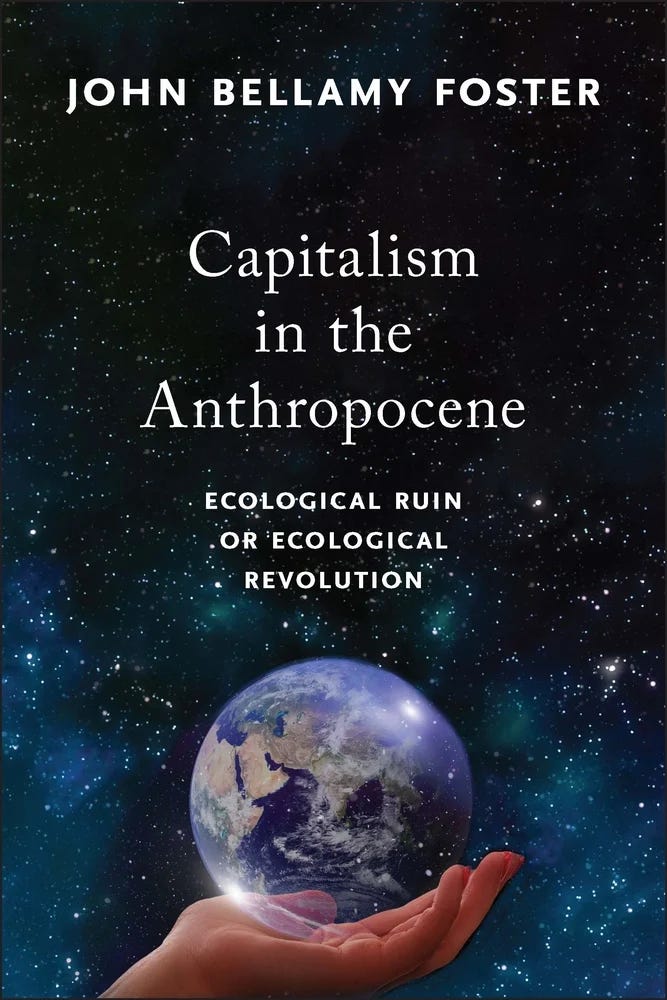
John Bellamy Foster is an important figure on the left. There are few, if any, who have done more to merge Marx’s original writings with a scientific understanding of our current ecological and climatological crises brought about by capitalist accumulation. I share an ecosocialist worldview similar to that of Foster’s, and for that reason I recently read his 2022 book Capitalism in the Anthropocene: Ecological Ruin or Ecological Revolution. In the spirit of socialist discourse I want to organize some of my thoughts about why I found this book complicated and perhaps only of limited use to the ecosocialist movement we need right now. And ultimately it left me wondering who this book was for.
Foster opens the book by arguing that the Marxist ecological framework views economic and environmental crises as two sides of the same capitalist coin. He goes on to state that our current moment is defined by a dual struggle: the inner human need for freedom from exploitation and the simultaneous battle for a safe and livable planetary environment. This is a view I wholeheartedly agree with. In fact, there are few things in this book that I don’t agree with, but more on that shortly.
Capitalism in the Anthropocene is organized into three sections. The first, titled “The Planetary Rift”, is an examination of Marx’s “metabolic rift” of capitalism and an integration of the theory into our modern ecological understanding. Foster traces what he calls the “three critical breakthroughs of ecological Marxism”.
These breakthroughs include the discovery of the ecological value-form in Marx’s original analysis, the recovery of Marx’s metabolic rift theory, and the retrieval of Marx’s economic and ecological crisis duality present within capitalism. Collectively, Foster argues, this framework not only makes Marx’s critique of capitalism wholly compatible with modern ecological critiques of capitalism, but also shows that Marx had a remarkable grasp of ecological concepts.
This is all well and good (if not new, since Foster has written several books on this already) for a text that seeks to lay out an ecosocialist vision, grounded in Marx’s critique, for the current moment. Unfortunately, that is not what Foster had in mind for Capitalism in the Anthropocene.
From here, the books takes a hard, academic, turn. Part two, “Ecology as Critique”, is a muddled section in which Foster both traces a historical development of ecological and Marxist theory overlap, and also takes pointed shots at other environmental Marxist thinkers with whom he disagrees.
It’s beyond the scope of this review to do a full accounting of this lengthy section, but there are two elements worth addressing. The first is Foster’s emphasis on rise of the “ecosystem” concept in the science of ecology during the 20th century. For his part, Foster does an adequate job of tracing this history and its revolutionary implications for ecology as a science, as well as making a compelling argument that Marx’s thinking was not an insignificant contribution to the development of the ecosystem concept put forth by Arthur Tansely and later advanced by Howard T. Odum.
Foster places considerable importance on Odum’s contributions to the theory of unequal ecological exchange under global capitalism via his concept of “emergy” (where global capitalist trade produces an ecological debt in wealthy nations due to the environmental exploitation of poor ones). In this discussion Foster draws some novel connections, if in an overly academic approach, in an interesting fashion. However, he seems to miss that while the ecology discipline has fully embraced Tansley and Odum’s ecosystem framework, it as been almost entirely shorn of its original radical and anti-capitalist characteristics in the dominant scientific literature.
This could be seen as a benign omission if it weren’t for the second noteworthy aspect of Foster’s “Ecology as Critique”. In total juxtaposition to his “ecological Marxism”, Foster devotes an entire chapter to criticizing (and willfully misunderstanding) radical environmental geography. The primary target of his criticism is geographer Jason W. Moore, who Foster has had an ongoing back-and-forth with in what can only be described as the most pedantic of academic disputes over the use of the terms “Anthropocene” (by Foster) and “Capitalocene” (by Moore).
Again, it’s impossible to fully articulate the specifics of this dispute, but what it boils down to is a debate between Foster’s entrenched materialism and orthodox Marxism vs. Moore’s (overly literary) commitment to relations, networks, and constructionism. In less academic language, Moore has criticized Foster’s use of the term “Anthropocene” in favor of his Capitalocene theory that seeks to illuminate the ways in which capitalism itself is responsible for not only producing the ecological crisis we find ourselves in, but also the very way that society comes to understand that crisis, and ultimately nature itself.
The fact that neoliberalism has entirely co-opted concepts like the “Anthropocene” in order to place blame on all of humanity, along with ideas like a carbon footprint that promote individualist solutions rather than systemic changes, seems entirely lost on Foster. In fact, he goes on to include other radical, Marxist, and environmental geographers like Neil Smith, Noel Castree, and Bruce Braun in his criticism of Moore as “hyper-capitalist”. Basing this all on a loose connection to Bruno Latour and the Breakthrough Institute, Foster instead reveals his near total lack of understanding of the environmental project within human geography that seeks to understand the way in which society influences its own understanding of nature.
What’s more is that, in stunning contradiction, Foster simultaneously makes nearly identical claims to the social aspect of nature as human geographers do when he discusses Marx’s nature-society dialectics, Max Weber’s environmental sociology, and the relational “oneness” between humanity and its environment.
Another glaring omission in the text is the almost complete absence of the work of Murray Bookchin. Foster goes to great lengths to (accurately, I will add) elucidate the role of Engels’s dialectical nature in shaping ecological thought, perhaps as much or more so than Marx himself. However, he seems to entirely miss (or deliberately ignore) the work of Bookchin, who did more than any other 20th century ecological thinker to recover and advance Engles’s writings on the dialectics of nature. Perhaps this is due to the now-centuries long “rift” between leftist anarchism and Marxism.
There’s a lot more I could say about Capitalism in the Anthropocene. In fact there’s a whole other section, titled “The Future of History”, which I haven’t summarized here. Unfortunately this section has more to do with re-hashing the points Foster made in Part Two than examining where ecosocialism might go from here. He does pay lip service to the coinciding economic and ecological crises eventually leading to “ecodemocratic” and “ecosocialist” revolutions, but has virtually no interest in the specific type(s) of organizing (current or future) that might produce said revolutions.
All of this brings me back to my original question. Who is this book for? Those interested in bringing about an actual ecosocialist future will find little of use in the pages here. Foster instead spends most of his words trying to convince the reader that all current ecological critiques of capitalism can be traced to Marx himself. And, to some extent, perhaps there are elements of truth to that, but it begs the question: Does that really matter? The hyper-specific extent to which Marx understood the science of ecological dynamics seems, to me, a somewhat irrelevant and academic exercise.
It seems sufficient to say that yes, Marx’s original writing bears similarities to our current scientific understandings, and yes, his critiques are wholly compatible and a modern ecological critique. Now what do we do about it?
For someone as stooped in Marx’s words as Foster, it is ironic that Capitalism and the Anthropocene misses some of the most important. Marx’s project was always to change the world, never to merely interpret it.