

The Incredible Shrinking Shrew
By Loren Merrill

The following is a guest essay provided by Northern Woodlands Magazine and sponsored by the Wellborn Ecology Fund of New Hampshire Charitable Foundation: nhcf.org. Be sure to subscribe to Brief Ecology for more ecological writing and essays!
The Incredible Shrinking Shrew
By Loren Merrill
Last autumn, I was canoeing in a quiet saltwater cove on the Maine coast when I realized I had a tiny stowaway onboard. A masked shrew (Sorex cinereus, also called the cinereus or common shrew) was huddled in the boat’s bow, trying to disappear into the nose of the canoe. I was out on a solo photography trip (or so I thought) hoping to capture images of mink, seals, and birds. I knew about the shrew’s infamous metabolism: they have an average heart rate of 780 beats per minute and need to eat almost continuously throughout the day or they die of starvation, so I figured I would make a truncated trip. After 10 minutes or so, the shrew became active and started exploring the canoe’s interior. After 20 minutes, it began trying to scale the steep sides of the canoe, and I realized I would have to head back to shore or risk having the shrew expire on the trip.
Once on shore, I ushered the shrew out of the boat, and it vanished into the leaf litter, presumably to find its next meal. Masked shrews have a generalist diet and will eat just about anything they can find and subdue: worms, insects, arachnids, snails, amphibians, other small mammals, small bird eggs and nestlings, as well as seeds, nuts, and fungi. In addition to their wide-ranging diet, masked shrews are the most widely distributed shrew in North America, inhabiting most of the northern half of the continent.
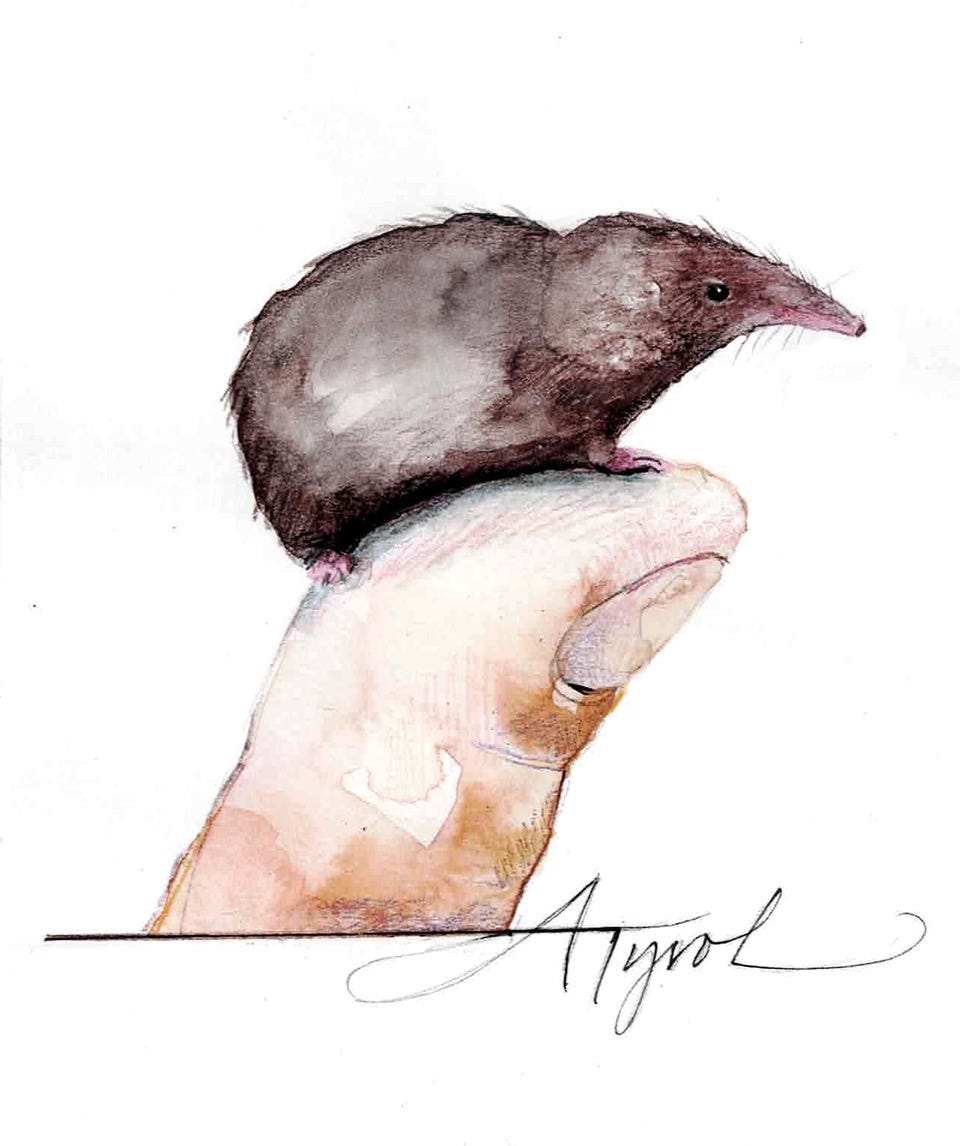
Masked shrews are one of our smallest mammals, tipping the scales at between 3 and 6 grams (one to two pennies), with a 2.5-inch-long body, and a 1.5-inch tail. They have a long, pointed snout full of sharp teeth, and a powerful nose surrounded by extremely sensitive whiskers. Their small size belies an outsized appetite; their infamous metabolism, mentioned above, requires an impressive number of calories to fuel it. Masked shrews can consume three times their body weight in a day, or the equivalent of a 150-pound person eating 1,800 quarter-pound burgers. During periods of rest, masked shrews can enter a state of torpor, dropping their body temperature, heart and breathing rates, and subsequently reducing their energy requirements. But torpor is a short-term energy fix, and these diminutive eating machines remain active throughout the winter. Winter presents a one-two punch of challenges for these mammals: their primary food source (invertebrates) becomes scarce, and the colder air temperature forces them to burn more energy to maintain their body temperature.

To help offset these cold-weather challenges, masked shrews have evolved an unusual ability: they shrink in the winter. And this is not just a reduction in body mass; their skeletons, including their skulls, also get smaller. This is known as Dehnel’s phenomenon, and it has been documented in a handful of small mammals and weasels. It represents a form of phenotypic plasticity, in which an organism can express a different phenotype (the observable or expressed traits) in response to changing ecological conditions. Scientists do not yet have a clear picture of how the shrews are able to reduce their skeletal dimensions, nor how they regrow them in the spring, but the size reduction results in a decrease in their overall energy requirements.
Despite the energy savings they get from shrinking, masked shrews still need to forage almost constantly during the winter. Their small size and elongated body shape are well-suited for their semi-fossorial (partly underground) lifestyles, but their extremely high surface area to volume ratio results in a high rate of heat loss. Snow provides an important insulating layer under which they can limit the amount of heat loss, but the masked shrew’s internal combustion engine runs on overdrive for most of the winter. It is perhaps not surprising that very few masked shrews even approach the age of two years before their fires are extinguished. They have come to epitomize the “live fast, die young” lifestyle.
My encounter in the canoe underscored how close masked shrews exist to the edge of their physiological limits. Shrinking their bodies in winter helps keep them from falling off that edge.
Loren Merrill is a science writer and photographer with a PhD in ecology. Illustration by Adelaide Murphy Tyrol. The Outside Story is assigned and edited by Northern Woodlands magazine and sponsored by the Wellborn Ecology Fund of New Hampshire Charitable Foundation: nhcf.org.
Very interesting. I never knew of this phenomenon. I wonder if the slightly lower energy costs of a smaller body actually compensate the worse surface to volume ratio that comes with it.