
Eco-fiction Review | History of the New World
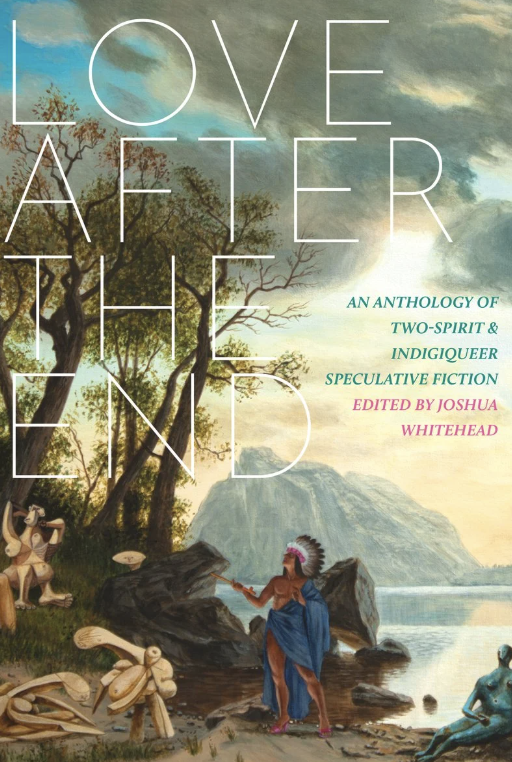
Cover of Love After the End
The new world in History of the New World, is not new at all-rather, it represents the same problematic longings and anxieties that have plagued capitalist society since its inception. The short story, written by Adam Garnet Jones, opens with a young, Two-Spirit nehiyow mother and her daughter leaving their home on a street lined with dead trees. For where we do not yet know, but Jones sets the stage aptly as our narrator wonders "Where will we bury our dead in the New World?"
Published in Love After the End (Joshua Whitehead's anthology of Two-Spirit and Indigiqueer speculative fiction), he narrative of History of the New World follows two young parents (Thorah and Em) and their daughter (Asêciwan) as they navigate the decision of staying on a dying planet Earth, or traveling to a newly discovered "twin" planet Earth in an alternate dimension. The futuristic sci-fi details end there, though, because this story is much more concerned with a narrative that is increasingly being thrust on us here, now, by capitalist billionaires: that if we want to survive as a species, we must leave Earth.
Of course, the story also serves as a dual metaphor, representing the fear and nostalgia behind both the current capitalist desire to escape the planet and the violent desire displayed by Europeans coming to the New World for its "pristine", history-less wilderness and vast natural resources centuries ago.
However, like the New World of North America, Jones's New World is not actually without its own history. Early in the story, a discovery of intelligent species in the New World sets off a conflict between Em and Thorah. The ensuring arguments function as a stand-in for our current debates; one side more willing to accept the end of the world than an alternative way of living, the other vice versa.
There is certainly more going on History of the New World. Issues of race and gender oscillate from foreground to background. But more than anything else, Jones's narrative forces us to confront the reality that we cannot escape our history, and that the future is on this planet.
Ben Lockwood is the editor-in-chief at Brief Ecology. Ben is an ecologist and geographer in the Department of Ecosystem Science and Management at The Pennsylvania State University. He holds a Ph.D. in Geography from Indiana University, and a M.Sc. and B.Sc. in Biology from Ball State University. Ben’s writing has been published in Nature, Clarkesworld Magazine, Area, Literary Geographies, and elsewhere. He also serves at the editor for both The Eco Update and The Rotting Leaf.