
by Nicole Lambrou
This essay draws on “Disaster recovery for whom? Insurance, zoning, and the exclusionary geographies of wildfire resilience,” by Nicole Lambrou, Chendi Zhang, Crystal Kolden, and Anastasia Loukaitou-Sideris, published in Environment and Planning D: Society and Space (2026) and available at https://doi.org/10.1177/02637758261435009
After the Camp Fire burned through the Town of Paradise, California, it had destroyed more than 80 percent of its structures and devastated the neighboring unincorporated communities of Magalia and Concow. Eight-five people died in that fire, which ignited the morning of November 8, 2026 from downslope winds that blew down high-voltage power lines onto dry vegetation, dead brush, and other flammable fuel.
Drive through the Town of Paradise today and you will see the signs of recovery across the landscape: fresh roofs, ember-resistant vents, cleared ground around new homes, structures built to tougher fire standards. By typical metrics, this is a resilience story. But look again and ask who lives in those homes.
For several years, my colleagues and I tried answering that question. We interviewed 35 residents, officials, and non-profit workers. We pulled insurance records from the state through public records requests. We compared census data from before and after the fire, and we looked at housing data both pre- and post-disaster. What we found was a town made safer by not providing housing options for the people who could least afford to stay.
Before the 2018 Camp Fire, the Town of Paradise was a place where people on small or fixed incomes could still own something. Retirees, working families, people in mobile homes, small one-bedroom houses and dwellings they had built themselves. Lots had been quartered, and then quartered again, as one resident put it. Rules were few, and enforcement was lighter still. Yet these somewhat informal structures, which were borne out of a need for affordability, were the most likely to burn in the Camp Fire. The real question is, seven years later, what has replaced them.
Safety’s price
Everything built in the Town of Paradise since the fire must meet California’s Wildland-Urban Interface (WUI) standards: class A roofs, ignition-resistant siding, enclosed eaves, multi-paned windows, and driveways wide enough for a fire engine. Each rule makes sense but stack them together and they create a steep price for attaining safety.
For example, take mobile homes, long one of the most affordable paths to owning a home. Prior to the fire, a local town housing agent explained, setting one up cost about $25,000 per site. After the fire and cleanup, the cheapest quote they could find was $75,000, with some as high as $150,000 for setup alone. By 2023 only a quarter of the towns mobile home parks had been rebuilt. As one resident indicated, if the point of a mobile home is to be low-cost, which runs counter to also making it fully compliant.
Compounding these issues is the minimum size rule, requiring new houses to be at least 750 square feet. “We had hundreds of one-bedroom, really small houses,” the housing agent explained. Many belonged to retirees, but those houses cannot be rebuilt. Their owners can build bigger, which requires more materials, more labor, higher property taxes and higher insurance.
Denser housing might ease some of this rebuilding pressure, and the town has responded by rezoning parcels for mixed use. But the Town of Paradise runs largely on septic systems, and without new infrastructure able to move beyond the Town’s main commercial corridor, to accommodate denser housing in more rugged topography, apartments are largely off the table. The results, one resident said, is that landowners “are getting kicked off their land that they own.”
The Unspoken Planner
If building codes decide what can be built, insurance decides who can afford to keep it. The state’s insurance data quantify this gap. In the Town of Paradise, coverage from private insurers fell from about 11,300 insured units in 2017 to approximately 4,300 in 2022. In Magalia, it fell from about 4,700 to just over 2,500. Some of that is homes that burned and never came back. But households that kept private coverage paid more everywhere, with average premiums climbing from about $700 to nearly $2,300. One word of caution is that these are descriptive trends, unfolding during a statewide insurance crisis in California, and these numbers can’t be pinned entirely on one fire. They do, however, match the stories we heard on the ground.
“The first people who came back to build seemed to be people who were well-insured,” a housing agent noted. And in most of those cases, they continued, those homeowners built back bigger. Conversely, nearly all the people we spoke with worked through the permitting process, secured a contractor, and a loan in order to rebuild, but realized they could no longer afford the new insurance quote, which was oftentimes up to four times what the rate was prior to the fire. Every decision about where to write a policy, and what to charge for it, shapes which streets fill back in and which stay empty, and who moves to them. That process was handled by insurers in the Town of Paradise as much as planners themselves.
The census shows the same shifts. Within the burn area, the number of occupied mobile homes fell by more than half between the 2013-2018 and 2019-2023 survey periods. Informal structures dropped sharply, as did homes without a full kitchen, plumbing, or heat. On paper, that might look like progress. In reality, the housing stock shrank so much that some kinds of precarity, such as overcrowding among homeowners, now make up the same or a larger share of what remains. People told us about families doubling up, living long-term in RVs on their properties, and renting on informal terms in order to stay near home. The cheaper, and more affordable, housing stock that comprised this landscape prior to the fire is mostly gone.
Climate justice scholars have a name for this, climate apartheid, which describes adaptation that secures some people’s lives and abandons others. The term typically gets applied to coastal cities and national programs, and the Town of Paradise shows it at work in a small foothill town, driven by nothing more dramatic than a building code, a square-footage minimum, and an insurance premium.
Where insurance is often sold as the answer to climate risk, the Town of Paradise makes its limits visible. Insurance can put a price on risk, and in doing so it cannot keep a community in place. This doesn’t entail rebuilding the Town as it was before, especially as looser rules in part turned a wildfire into a catastrophe. Sending lower-income residents back into the most flammable housing would be its own injustice.
Instead, the issue to be drawn out here is whether safety can be delivered without any commitment to affordability. Recovery could look different: It could include public subsidies for lower-income retrofits and support for manufactured housing that meets fire standards; It could fund the infrastructure that makes denser housing possible; It could back community land trusts and public insurance designed explicitly around equity. Markets will not build any of that on their own. Fires are becoming bigger and more impactful across California and the West. More towns will stand where the Town of Paradise stood in 2018. The question is how to make them safer, but especially who they will be safe for.
This article is part of The Fires That Haunt Us
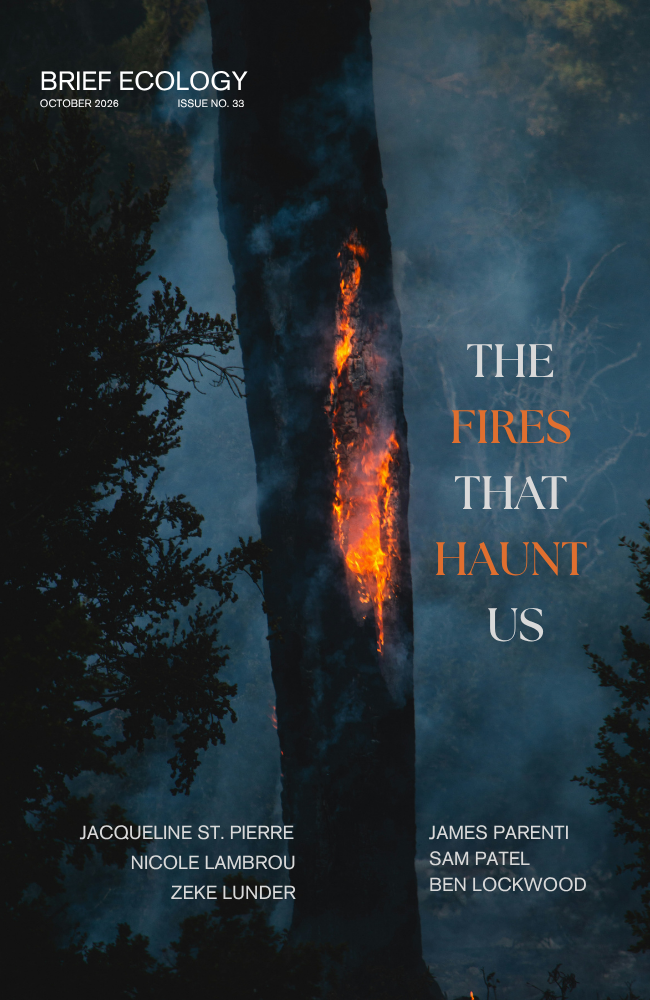
(ebook)
In This Issue
Nonfiction
Introduction: The Fires That Haunt Us | Ben Lockwood
We didn’t start the fire | Jacqueline St.Pierre
Who Returns To Paradise | Nicole Lambrou
An Interview with wildfire geographer Zeke Lunder
Eco Review: Red Flag Warning and the Mutual Aid Difference | Ben Lockwood
Fiction
Dry Season | James Parenti
Poetry
#TheRottingHaiku | Roblin Meeks
Photography
Cover Photo | Sam Patel
Nicole Lambrou is an Assistant Professor at the California Polytechnic State University, Pomona College of Environmental Design, and the founder and executive director of the nonprofit tinkercraft. Her work centers on climate risks, and she is currently studying differential exposure to wildfires disasters.