
Geography and the Ecopolitics of Food
A review of Favela Resistance from PM Press
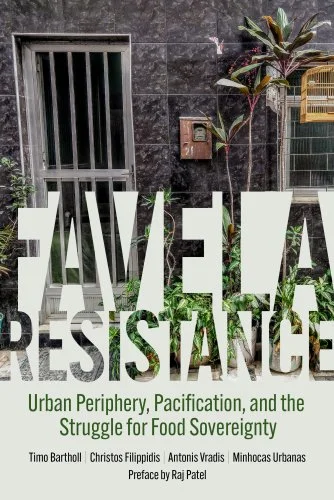
Cover of Favela Resistance
from PM Press
Eating is a political act. That, more than anything, is the premise of Favela Resistance: Urban Periphery, Pacification, and the Struggle for Food Sovereignty, from PM Press. Taking the favelas (translated as “slums” or “ghettos”) of Rio de Janeiro as its case study, this book unpacks the multi-dimensional layers of spatial, economic, social, cultural, historical, and geopolitical factors that influence how and what people in the favelas of the city eat.
In the opening preface, Raj Patel explains liberalism’s failure to address the issues of food and hunger. The goal of liberalism, as Patal argues, is not to end hunger, but to manage it. This means regulating who has access to which types of food, while denying both producers and consumers of food sovereignty over those decisions. Patal goes on to define food sovereignty as the set of preconditions necessary for people to eat with dignity, or “A right to have sovereignty over the food system”.
This is a more specific and precise political concept than food security, which hinges more on the access to adequate calories to keep one alive. But as the essays in Favela Resistance reveal, Rio de Janeiro’s favela’s have been forgotten, abandoned, and simultaneously oppressed by the Brazilian government in order to bring them in line with the broader system of global capitalism.
In the book’s first essay, Thinking About the Favela Through Food and Through Time, Antonis Vradis understands the favelas as spatial and temporal phenomena. Spatial in the sense that their peripheral location relative to Rio’s center is both a historical artifact and an influential factor of food access. Temporally, the favelas are separated from the rest of the city by the time it takes for residents to traverse the spatial distance. Mobility becomes a key hinge on which food access turns. This urban-periphery dynamic is crucial to understanding the class-based struggle for food sovereignty not just in Rio de Janeiro but in virtually every city under the spatial logic of capitalism.
Expanding on these topics, Minhocas Urbanas next chronicles some of the history that led the unequal distribution of access to healthy food in the favelas. Urbanas discusses the fact that Brazil is the world’s largest user of agrotoxins and pesticides, and most organic fairs and stores are in high-income neighborhoods, leaving the residents of the favelas with limited options when it comes to avoiding contaminated food. In addition, space limitations for vegetation renders the favelas neighborhoods as effectively urban heat islands. However, this has not stopped favela residents from planting urban gardens both with and without government support. Although Urbanas goes on to assert that, ultimately, favelas food sovereignty requires the necessary conditions, resources, and support for production.
Timo Bartholl’s essay, Favela Resistance and the Struggle for Food Sovereignty in Rio de Janeiro, defines the parameters of food sovereignty and its necessity in reaching food security. Citing Via Campesina’s “What Is Food Security?”, Bartholl outlines what food sovereignty must include: 1) Prioritizing local agriculture for food consumption rather than trade; 2) The right of farmers and peasants to decide what they produce and right of consumers to decide what they eat; 3) The right of countries to protect themselves from too low priced agricultural and food imports; 4) Linking agricultural costs to production costs; 5) Local populations taking part in local agricultural policy choices; and 6) The recognition of women farmers’ rights.
Lastly, Pacifying Hunger: Lessons from/for Rio’s Urban Periphery by Christos Filippidis reveals the ways that state proponents of global capitalism’s neoliberal project have used food as both a weapon and a form of coercion to pacify populations. Fillipidis draws lines connecting counterinsurgency tactics in South Asia to the Green Revolution in South America. Arguing that if food is a “security” (i.e. police/military) issue, then dietary needs become a thing to be managed, regulated, and controlled. When the goal is to pacify a revolutionary people, food is an effective method. Fillipidis also reveals how the intent of the Green Revolution was never to address issues of food insecurity, but rather to slow the spread of communism by managing populations via their access to food. If emancipation requires food sovereignty, the Green revolution was food imperialism.
As a whole, this collection of essays illuminate much more than simply the historical and geographic dynamics of food access in Rio de Janeiro. By placing the lens inside the favelas and turning it outward, the political and economic structures controlling food access everywhere come into focus. Global capitalism produces food for its exchange value, not its nutritional value. This simple fact reverberates across space and time, determining who gets to eat what, and when. Escaping the logic of capitalism requires integrating urban, peri-urban, and rural networks. It requires reclaiming local control over what is produced and consumed. And it means learning from class-struggles like those in Rio de Janeiro’s favelas.