
Beyond Clean-Ups: Joy, Discomfort, and Ecopedagogy in Wasted-Edgelands
by Professor Ria Dunkley
When I joined the local teachers in their Scottish primary school class, working through the John Muir Award with their pupils, I witnessed environmental pedagogy at its most innovative. The school was just twenty minutes from Loch Lomond and The Trossachs National Park, yet the teaching staff knew many of their pupils had never had the opportunity to visit it. Embracing the John Muir Trust’s core ethos of valuing local, everyday wild places in the most inclusive sense, the teachers deliberately took their class to a nearby neglected woodland bordering a river and an active whisky bond warehouse. Rather than treating outdoor learning as something that requires a trip to a distant national park or reducing it to a quick clean-up exercise, my ten-week research project partnered with the school to follow the class’s John Muir Award learning journey, which included exploring this waste-edgeland: a space shaped by industry, abandoned debris, and local warnings that “it’s creepy”.
Equipped with an on-body camera, I set out with the group one drizzly Wednesday to capture their unmediated perspectives. The children stepped into the damp, uneven terrain. Away from classroom walls, the body-cam footage captured the simple, genuine joy of being outdoors. Laughter and spontaneous conversation broke out as they shared memories of family holidays, pointed out wild nut trees, and proudly gathered flowers. The woodland offered a space to be, where personal memories and ecological awareness came together naturally. As one child observed while examining a fallen trunk: “Did you know when they cut down the trees and they’ve got the lines, if you count all the lines, that means how old they are?”
Yet this joy did not hide the site’s difficult realities. Moving through the undergrowth, the children encountered waste not as a passive nuisance to be erased, but as a forensic record of human presence. Examining a patch of scorched earth and shattered glass, one pupil, Cairn, reconstructed the scene: “Somebody got the spray can and put it against the glass bottle and the bottle exploded… and that’s why that’s happened.” Tracing the trees blackened on one side by Baudoinia compniacensis (whisky fungus) fed by ethanol vapours from the neighbouring bond, another child noted: “It’s smooth, and then you go down to rough.” Rather than turning away, the children stayed with the discomfort of these wasted-edgelands, learning to read industrial residues as ongoing ecological presences.
Back in the classroom, the tone shifted as we made sense of what we had collected. The children tallied their items and researched global environmental statistics. Connecting the debris from their local woods to global plastic accumulation in ocean gyres transformed local curiosity into deep shock. Confronted with the data, one child exclaimed: “That’s too much. I don’t like that.”
That immediate reaction opened up a deeper critique. The debris was no longer just litter; it was material evidence of wider systems of production, consumption, and disposability. By grappling with the numbers, the children began asking searching questions about why these materials were left behind, and they began to question the adult decisions that allow such waste to accumulate.
Living through an era of climate and ecological disruption requires an environmental pedagogy that goes beyond traditional clean-ups or pristine escapes. If educational initiatives like the John Muir Award and primary school curricula are to foster genuine ecological literacy, award providers and educators must make a concrete shift, explicitly validating and incorporating wasted-edgelands into their learning frameworks. We must give young people space to experience both the joy of being outside in their everyday surroundings and the permission to sit uncomfortably with damaged landscapes. By learning with children about how we can care for the damaged, everyday places where they live, rather than only distant places, we equip ourselves to confront the systemic realities of a wasted world.
This piece draws on: Dunkley, R. and Somerville, K. (2026). “Staying With the Waste: Litter, Learning and Slow Violence in Wasted‐Edgelands.”Antipode. https://onlinelibrary.wiley.com/doi/10.1111/anti.70153
About the Author
Ria Dunkley is Professor of Environmental Pedagogy at the University of Glasgow. Her research explores how people, especially children and communities, learn to care for the places they live, including damaged and post-industrial landscapes. She leads the Community Collaboration Research workstream of GALLANT, a large Glasgow-based urban sustainability programme.
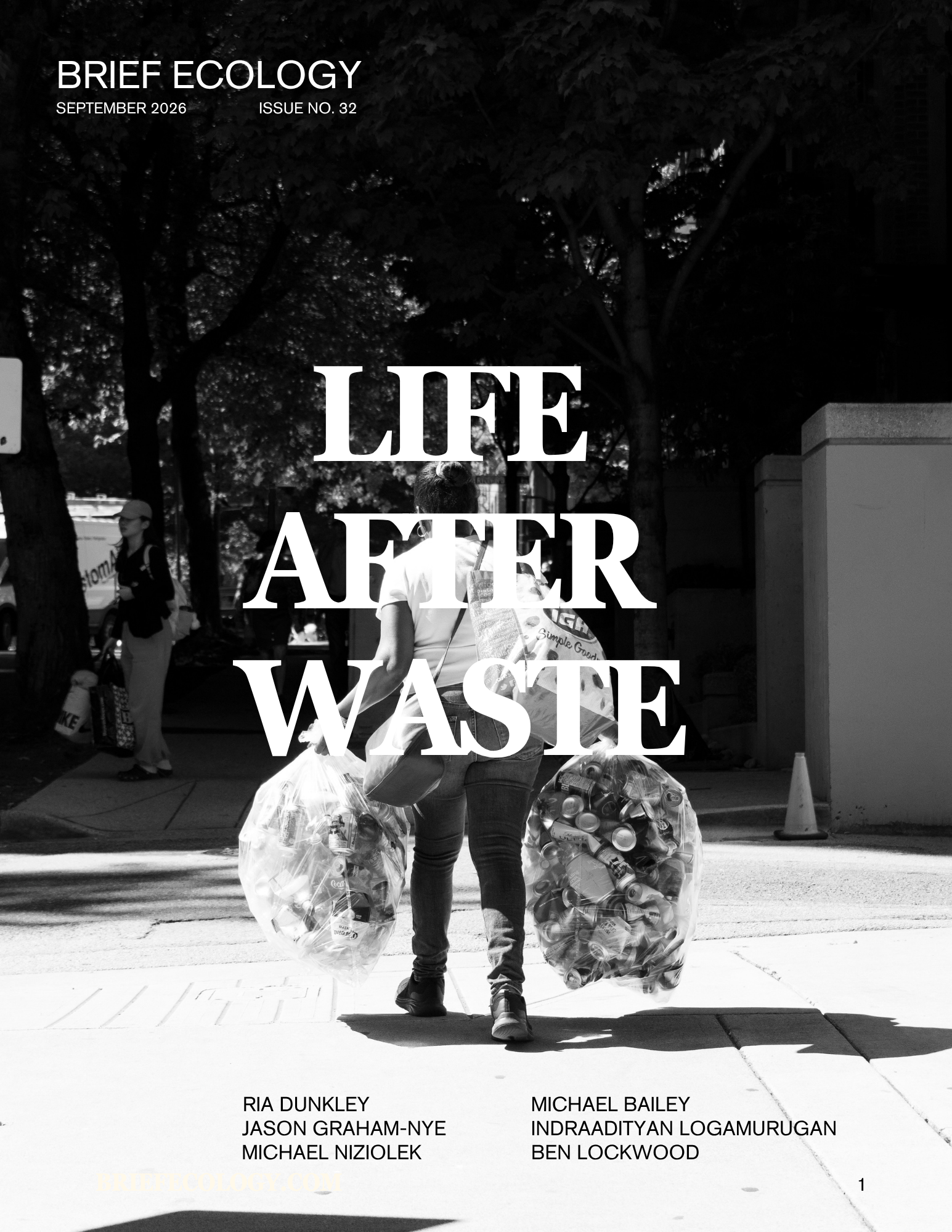
This article is part of the September 2026 issue of Brief Ecology.
(ePub)
In This Issue
Non-fiction
Introduction: Life After Waste | Ben Lockwood
Beyond Clean-Ups | Professor Ria Dunkley
What it takes to give diapers a life after waste | Dr. Jason Graham-Nye
Notes From A Radical Ecologist | Interview with Conservationist Michael Niziolek
Eco Review | Space-Time-Nature-Gender Dialectics (or new from the old) in Joe Koch's Take Him
Fiction
The Rotting Leaf | Reclamation by Michael Bailey
Poetry
#TheRottingHaiku | by Kamen Nedev
Photography
Cover Photo | by Indraadityan Logamurugan