
What It takes to Give Diapers a Life After Waste
Dr. Jason Graham-Nye
Adjunct Associate Professor, School of Design
University of Technology Sydney, Australia
A used diaper disappears into a bin in seconds. For parents, that ends one small task in a day crowded with feeding, washing, working and trying to get some sleep. For the environment, the story continues. The plastic, absorbent materials and human waste still have to go somewhere.
Compostable diapers offer an intriguing possibility: collect them after use and process them into compost, giving their materials another purpose. But developing a product that can be composted is only part of the challenge. It must also work on a wriggling baby, fit into family routines and reach a facility equipped and permitted to process it.
Our research at the University of Technology Sydney explored what happens when that possibility meets everyday life. We found that moving beyond disposable diapers requires changes stretching from the changing table to the institutions that make disposability feel normal.
We worked with 20 families in Sydney in a one-month trial of a compostable diaper, alongside a proposed collection and composting service. Through home interviews, demonstrations of changing routines and diaries, we explored how the alternative fitted into parents’ lives. We also interviewed management in supermarkets, childcare, local government, waste regulation and composting to understand the wider system.
Four closely connected factors emerged: convenience, reliability, price and social norms. Together, they help explain why disposable diapers remain so difficult to displace.
Convenience sounds simple until we look at everything a parent is managing. One mother described preparing for a work trip while washing bottles, packing her child’s daycare bag and planning how to leave early without waking the household. Another spoke of laundry increasing from roughly once a week before parenthood to sometimes twice a day.
In that setting, a diaper is part of an already demanding routine. Even a small additional task can be too much.
The compostable product we trialled had two parts: an absorbent component designed for industrial composting and a reusable, washable wrap to hold it in place. Almost all participants found it fiddly to put on. Getting the fit wrong could mean leaks, more washing and another problem to solve.
Reliability therefore mattered as much as convenience. Parents needed confidence that a diaper would work, particularly overnight. Some trial participants returned to their usual disposables after leaks. One stopped the trial on day five because she felt the product was not good enough.
These findings are valuable precisely because the trial did not deliver an uncomplicated success story. An alternative has to perform under the conditions in which people actually use it. Environmental promise will struggle to compensate for disrupted sleep or extra laundry.
Price created another obstacle. Participants broadly expressed willingness to pay a modest premium, up to around 10%, for the compostable diaper itself. There was much less interest in paying for a dedicated collection service.
That creates a difficult equation. Collection and composting are essential to the proposed environmental outcome, yet families may be reluctant to pay separately for them. A compostable product sent through the ordinary rubbish system cannot be assumed to deliver the benefits of industrial composting.
The fourth factor, what feels normal, reaches well beyond the household.
Participants described encountering disposable diapers in maternity hospitals, take-home baby bags, supermarkets and childcare centres. These repeated encounters teach parents what a diaper looks like, how to use it and which products to trust. By the time a family considers an alternative, an established routine may already feel almost automatic.
Familiarity can also influence how parents interpret failure. One participant explained that an occasional leak from a widely used disposable seemed like an ordinary part of parenting. A leak from an unfamiliar alternative prompted doubts about both the product and whether she was using it correctly.
Our industry interviews showed how these household experiences connect to commercial decisions. A supermarket executive explained that stocking the right brand and size matters because parents may take their entire grocery shop elsewhere if their preferred diapers are unavailable. Childcare providers likewise valued familiar products that worked reliably within existing routines and waste systems.
These arrangements reinforce one another, making disposables easy to buy, use and discard.
What could change this?
Manufacturers need to develop alternatives that meet families’ expectations for fit, absorbency and ease of use. Collection must be convenient and affordable, with suitable processing facilities available. Policy could help distribute responsibility for waste management, including through requirements for producers to contribute to collection and treatment costs.
Hospitals, antenatal education and childcare centres could also help families become familiar with alternatives, provided those alternatives perform well and have a functioning disposal pathway.
Composting itself needs careful attention. Our research identified regulatory barriers around human waste and concerns about contamination by conventional plastic diapers. These require workable arrangements between manufacturers, collectors, composters and regulators.
Our study was small and short. Participants were mainly English-speaking families from middle- to higher-income backgrounds, and our household research focused on mothers. We did not establish the service’s long-term commercial viability or measure its full environmental footprint. Larger, longer trials involving more diverse households are needed.
Nevertheless, the central lesson is clear. Asking parents to make a greener purchase leaves much of the problem untouched. Their choices take place within systems designed around disposability.
For diapers to have a useful life after waste, that next life must be planned before the first diaper is used. Product design, everyday care and waste infrastructure all need to work together. Parents should be able to trust that a diaper will keep their baby comfortable and that, once collected, its materials will reach the place where their next use can begin.
Postscript
Since completing this research, a pilot of the compostable diaper and service was launched in Samoa, an island nation in the middle of the Pacific ocean. The Pacific region’s 15 nations use 815 million diapers each year with most being discarded in the environment or ocean. Composting facilities have been established as has a dedicated door to door deliver and collect model. The pilot has proved successful as the existing diaper practice was able to be changed relatively easily. It is now rolling out nationally in neighbouring Tuvalu, a Pacific atoll nation of just 12,000 people to address that country’s plastic diaper waste crisis.
Dr. Jason Graham-Nye is Adjunct Associate Professor (Industry) in the School of Design and Society at University of Technology Sydney (UTS), Australia. He is also co-founder of The Greater Good Diaper Project, which replaces plastic diapers with a compostable service model across Pacific Island nations. He holds a PhD from the Institute for Sustainable Futures at UTS and is based in Samoa. URL: thegreatergood.global
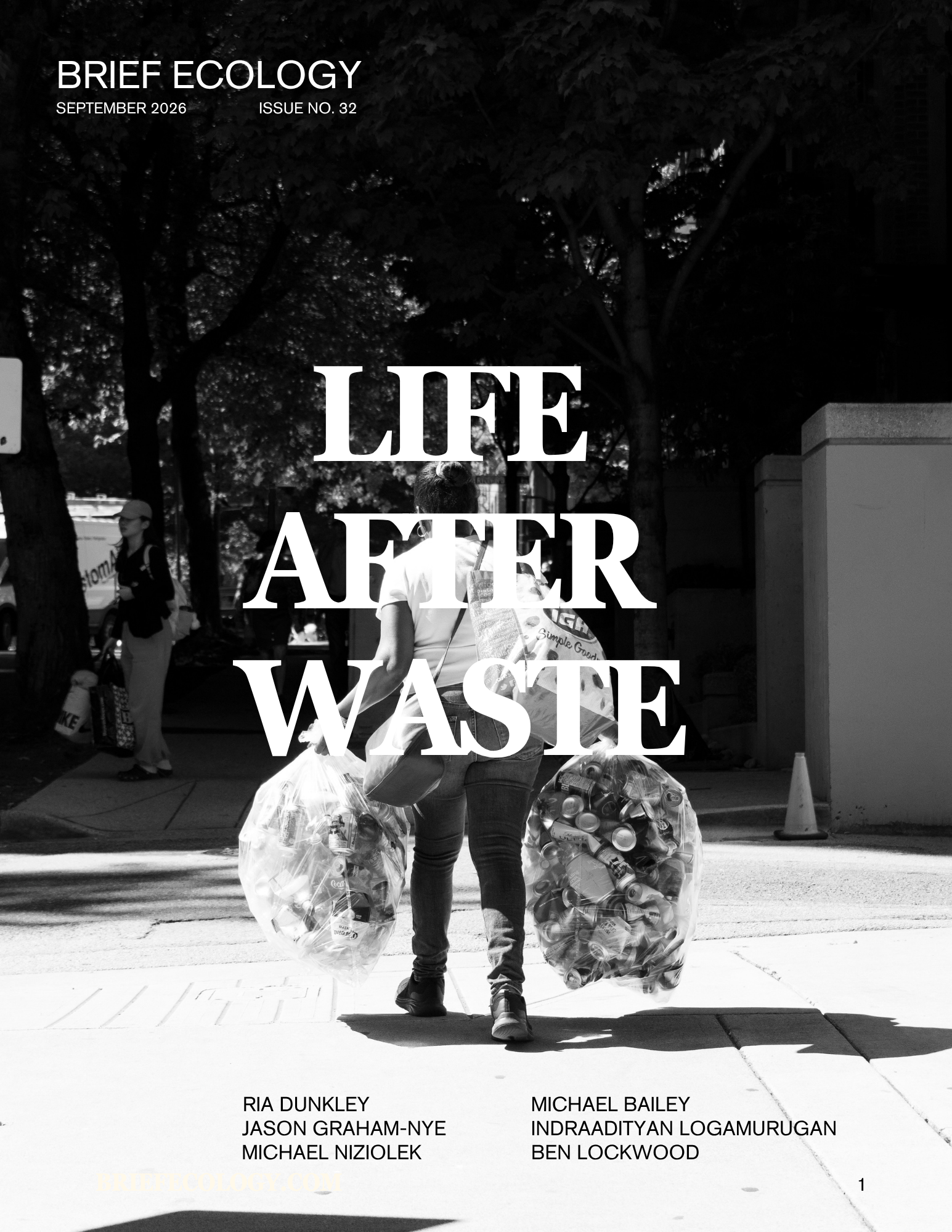
This article is from the September 2026 issue of Brief Ecology
(ePub)
In This Issue
Non-fiction
Introduction: Life After Waste | Ben Lockwood
Beyond Clean-Ups | Professor Ria Dunkley
What it takes to give diapers a life after waste | Dr. Jason Graham-Nye
Notes From A Radical Ecologist | Interview with Conservationist Michael Niziolek
Eco Review | Space-Time-Nature-Gender Dialectics (or new from the old) in Joe Koch's Take Him
Fiction
The Rotting Leaf | Reclamation by Michael Bailey
Poetry
#TheRottingHaiku | by Kamen Nedev
Photography
Cover Photo | by Indraadityan Logamurugan