
Eco Review | Space-Time-Nature-Gender Dialectics (or new from the old) in Joe Koch's Take Him
by Ben Lockwood
When done well, short stories do what novels rarely can: deliver an emotionally and artistically resonant narrative in a single reading experience. Literary geographer, Sheila Hones, refers to this as the compression and intensity of the short story form.[1] By concentrating a full narrative into a shorter text, the intensity (or density of narrative per text) increases, thus emphasizing the "micro-geographies", as well as the strategic gaps and ambiguities, that short stories often make literary use of.
Joe Koch's Take Him (published in Gavagai) has many such micro-geographies, and what I want to argue here is that Koch uses them to deliberately rupture the narrative in ways that open space for the new.
The story begins with an ambiguous narrator hiking along the forested shore of an island (also ambiguous). Throughout this hike, we take a journey inward with the narrator, traveling to memories of past traumas and abuses. The hike itself is thus both the spatial form and temporal function of the story here, and the movement of the narrator is key to the dialectical relation.
During the hike, Koch puts the narrator in "communion" with nature via the relation between movement and attention (literally). Here, as the narrator oscillates between memory (the past) and observation (the present), this movement through time creates a contradiction with his movement through space. Both cannot proceed simultaneously, and yet they do.
Koch expresses this contradiction through the apparent movement of trees. Acting as temporal archives, trees are components of the natural landscape that should be fixed in space, but not time. Here, though, they suddenly become mobile. Or seem so at least. This literal movement, in an eerie turn, contrasts with the narrator, who increasingly does become–like trees as we usually see them–fixed in space, but not time.
The resulting spatial and temporal ruptures are important. Koch's narrator experiences a blurring of past and present, as well as the past and with an alternate past. Dissolving the boundaries between space and time has meaning on this island, and since the forest acts as a spatial archive, a breaking down of the rules of nature follow in turn.[2]
Distinctions between the human and non-human–or rather, the narrator and his surroundings–diminish as the narrator laments a lost childhood. But, with this diminished distinction comes also a diminishment of the separation between male and female[3], allowing the narrator to reconcile past movement.
So, from the opened space-time comes opened nature, and from opened nature comes opened gender. Thus, new possibilities; the new from the old; newness itself, born in the heart of a tree.
And our narrator takes him.
The commensurability of form and function in Koch's Take Him–through narrative disjunction–is, partially, the result of the aforementioned compression and intensity of the short story in general. But Koch is doing something more, not just compressing but rupturing the narrative, which exacerbates the disjunction throughout. The move is dialectical, opening up space, time, nature, and gender, and thus making room for the new in the old.
Notes
1. See: Hones, S. (2010). Literary geography and the short story: Setting and narrative style. Cultural geographies, 17(4), 473-485. for a more detailed analysis on geographies of the short story form.
2. In Forest Imaginaries: How African Novels Think (Columbia University Press., 2026) Ainehi Edoro presents the forest as a spatial archive in African literature but does not confine the metaphor to this particular tradition. Indeed, Edoro notes that the spatial aspects of forests permeate much of global literature.
3. Doreen Massey in For Space (citing Elizabeth Grosz’s Space, time and perversion) explores the historically gendered aspects of time and space–where time has been ascribed the masculine, male domain, and space often associated with femininity.
Ben Lockwood is an ecologist and geographer in the Department of Ecosystem Science and Management at The Pennsylvania State University. He holds a Ph.D. in Geography from Indiana University, and a M.Sc. and B.Sc. in Biology from Ball State University. Ben’s writing has been published in Nature, Clarkesworld Magazine, Area, Literary Geographies, and elsewhere. He is the founding editor of Brief Ecology.
This article is part of the September 2026 issue of Brief Ecology
(ePub)
In This Issue
Non-fiction
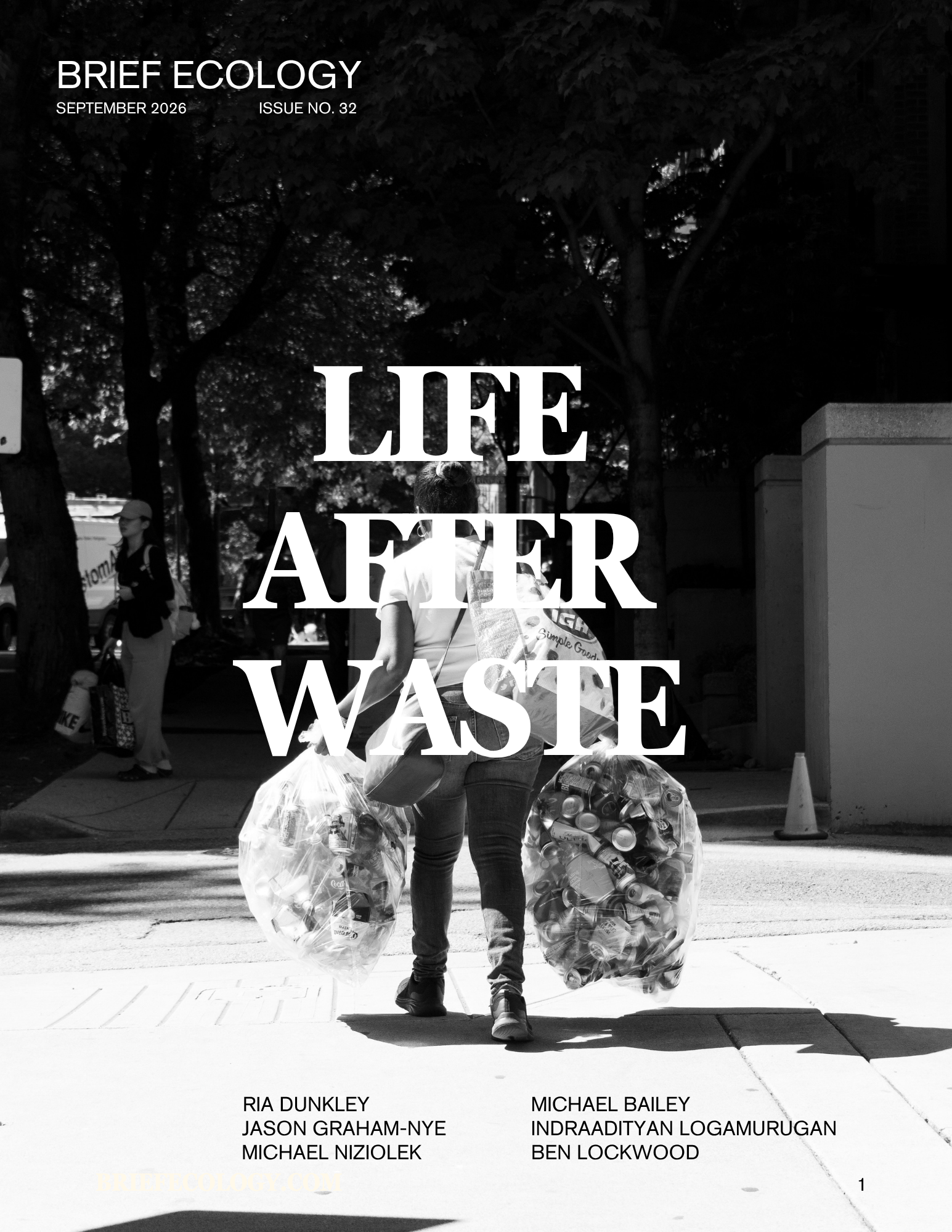
Introduction: Life After Waste | Ben Lockwood
Beyond Clean-Ups | Professor Ria Dunkley
What it takes to give diapers a life after waste | Dr. Jason Graham-Nye
Notes From A Radical Ecologist | Interview with Conservationist Michael Niziolek
Eco Review | Space-Time-Nature-Gender Dialectics (or new from the old) in Joe Koch's Take Him
Fiction
The Rotting Leaf | Reclamation by Michael Bailey
Poetry
#TheRottingHaiku | by Kamen Nedev
Photography
Cover Photo | by Indraadityan Logamurugan