
Notes from a Radical Ecologist | An Interview with Conservationist Michael Niziolek
Interview by Ben Lockwood
Michael Niziolek is a former biology teacher and conservationist who, for the last several decades, has been working to restore 150 acres of wetland in Minnesota. He was gracious enough to answer a few of my questions about his work. I hope you find the following interview as interesting and informative as I did.
Ben Lockwood: I recently came across an article about your work that said you’ve been engaged in a decades-long process of restoring 150 acres of wetlands in Minnesota. What set you on this journey? And did you know it would be this long of a project when you began?
Michael Niziolek: As a child I spent numerous hours outdoors exploring the natural world and spent many hours capturing it in my mind, on canvas and through photography. I also remember the first time I observed heavy equipment clearing sites for human dwellings and started to ask myself the question if that was the best practice. I always knew it would take a long time but did not realize that project of restoration would lead to:
a.) the recognition of how significant Indigenous practices would be and that we must be an active part of the natural world.
b.) the importance of human disturbances such as fire, browsers and grazers.
c.) a process that would evolve so much in such a short period of time.
d.) a process of controlling nonnative species that would become a focus of so much of my effort.
e.) the recognition that wetlands are biosupermarkets.
(These biosupermarkets are an extremely important life-giving dwelling which spills its wealth of life into the uplands.)
BL: Why this land, specifically? Was it just that you happened to own the property? Do you have a unique connection to the area?
MN: The land was located on an early morning paper route that I had in my teenage years. I can remember quite vividly because it was on a bend in the road so the lights would shine into the property and therefore we had the opportunity to observe wildlife at that corner on many occasions.
The land was owned by John and Marolyn Huddleston. John was a custodian at Elk River High School in my first year of teaching. On a beautiful summer day I was out for a bike ride and saw that the Huddleston’s were selling their land and then approached them to see if they would be interested in selling the land to me. They said yes and with a contract of deed I was on my way to owning a good portion of the property.
When walking the property before purchasing it I noticed a ditch they cut through the center of the property and thought it had some potential wetland restoration possibilities. At that time I did not realize that it was a county ditch and it was connected to an elaborate tile system. Later I would recognize that the property had many drained wetlands which could be restored. Shortly after beginning the payments on the contract for deed I embarked on the first wetland restoration which required the impoundment of the county ditch. My college friend Bruce Weaver, a civil engineer, helped me with the engineering and design and later I would get approval from the county ditch authority. The control structure was then built with the help of friends, family and the US Fish and Wildlife Service.
BL: I imagine your background as a former biology teacher was helpful. In what way did that expertise inform your approach? How much extra (if any) education did you need in order to get started?
MN: Because of my education I recognize that some of the most important goals are to maximize biodiversity and create a functional biological system. In addition, I have learned that learning never stops. The more that I know the greater the recognition that I (we) know very little about these amazing biological communities. Lastly, we need to be enfolded by Indigenous Traditional Ecological Knowledge.
BL: Are there things you know now that you wished you’d known in the beginning? What challenges have you faced in restoring the wetlands?
MN: Invasive species need to be the focus of initial restoration efforts. These invasive species need to be removed with minimal impact on the existing remnant components of the biological community. Restoration of wetlands has to have a multi-faceted approach. The following have to be completed: Removal and control of invasives, re-establish the hydrology, prep the site for seeding and planting plugs, obtain native seeds and plugs for 40+ species of forbs, grasses and/or shrubs and/or trees, broadcasting seeds on snow and planting plugs in fall or winter, and establish a maintenance plan which incorporates natural disturbances. These disturbances are like pushing a reset button in the natural process of succession.
BL: What do you think it means to “restore” land? If nature is always in a state of change, at what point do we say, “Okay, now it’s restored”? How have you navigated that with your own environmental restoration?
MN: It is imperative that disturbances that existed historically be replicated and reinstated. The landscape must undergo these changes to maximize species diversity and ecosystem functionality over time. We will never be done, and human effort will always be essential in maintaining Minnesota’s native landscape. What a special opportunity to develop a relationship with the land.
BL: Habitat degradation is a global problem, but one that has a variety of causes across geographies. What’s driving it in Minnesota? And do you see the actions of private landowners as the primary way of addressing it?
MN: Agriculture (I say this with great sensitivity for humanity needs to feed humans and we need to think about the social interest of maintaining the family farm.) The traditional Family Farmer definitely has a very special relationship with the land which is also being transformed in a very special way. Human-caused climate change (just imagine how you feel when you are running a temperature of 100 degrees (98.7 +1.3.). Perhaps Mother Earth is feeling the same way today! The biggest challenge with human-caused climate change is the incredible swings in temperature and moisture patterns.
BL: What advice do you have for the next generation of ecologists? What do you think people who are interested in ecological restoration work should know?
MN: “We need to think in Big and Little ways”
Big: We need to ask the questions relevant to bringing keystone species back. (Bison, Elk, Beavers, Timberwolves………) and significant disturbances (fire) back into the fragmented system that we presently are restoring or preserving! We can potentially do this with technology through the utilization of virtual fencing, drones, radiotelemetry, GIS and strategically planned fire breaks.
We also must be certain not to exclude bison, elk and beaver from wetlands because they may play a critical role in creating disturbances which are essential in maintaining: biodiversity and functional shallow aquatic ecosystems of oak savannas, aspen oak parklands and prairies.
Little: We need to recognize the amazing life forms in our soils, from the thousands of different bacteria in a handful of soil to the diversity of smallest nematodes to an amazing network of hyphae that exist.
BL: Is there anything else that I didn’t ask about but that you’d like to share? Feel free to mention any books, resources, or other things you think are relevant or important.
MN: The potential to discover new things should bring the best and the brightest into the field of Ecology. Humanity simply does not yet understand the interactions of organisms and their environment, the functional aspects of an ecosystem, and the serviceability of the ecosystem for our well-being.
Wetlands are truly the biosupermarket of Minnesota. We need to be certain that these biosupermarket are part of the Upland community whether it is prairie, aspen-oak parkland, savanna or forest.
Beavers are one of the prominent managers of biosupermarkets in the United States.
Collaboration will enhance one’s effort to restore our landscape to a vibrant and functional system. I have the good fortune to work with John Riens and other members of the US Fish and Wildlife Service “Partners for Fish and Wildlife Program”, Amy Cazier with The Nature Conservancy and the Minnesota Land Trust Staff. I also should mention the support and help of members of my family and my friends.
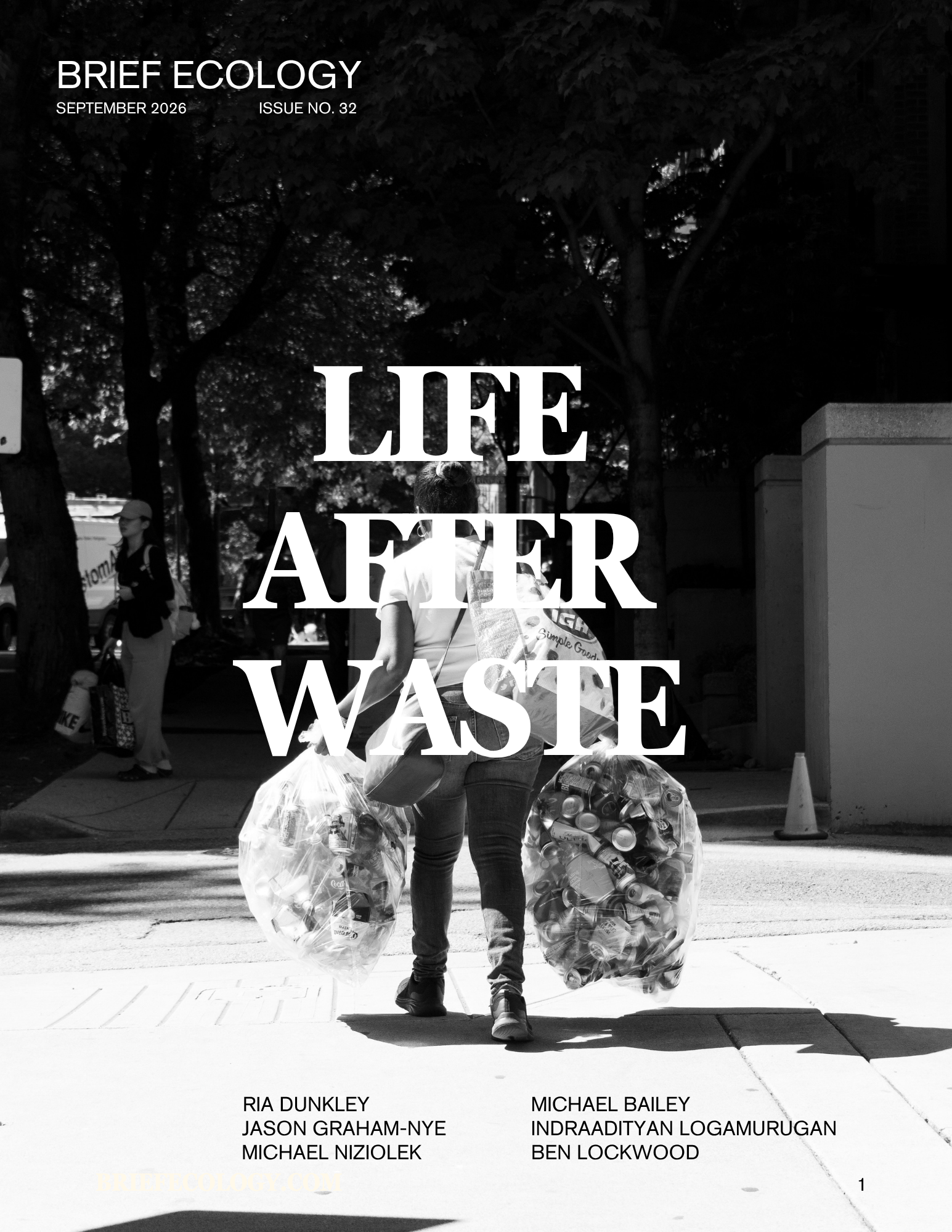
This interview is part of the September 2026 issue of Brief Ecology
(ePub)
In This Issue
Non-fiction
Introduction: Life After Waste | Ben Lockwood
Beyond Clean-Ups | Professor Ria Dunkley
What it takes to give diapers a life after waste | Dr. Jason Graham-Nye
Notes From A Radical Ecologist | Interview with Conservationist Michael Niziolek
Eco Review | Space-Time-Nature-Gender Dialectics (or new from the old) in Joe Koch's Take Him
Fiction
The Rotting Leaf | Reclamation by Michael Bailey
Poetry
#TheRottingHaiku | by Kamen Nedev
Photography
Cover Photo | by Indraadityan Logamurugan