
Reclamation
by Michael Bailey
They returned him to Willow as twelve pounds of amended soil in a biodegradable sack, along with a sapling of a western red cedar whose roots had already begun feeding from him.
The woman at the reclamation center carried this new version of her husband with the efficiency of someone accustomed to placing grief into other people’s hands. Everett’s name, birth and death dates, his reclamation number, and a triangle of green arrows pointing at each other covered the clear plastic bag. One of the lower branches had broken during transport and was grafted back into place on the trunk with white tape.
“Excellent survival rate,” the woman said. “High carbon retention.”
“Is all of him there?”
“The recoverable organic matter, yes. Anything inorganic, such as metals and medical components, enter separate—”
“He had a plate in his wrist.”
“Titanium, yes. That would have been recycled.”
“For what?”
“Construction, medical use, transportation. Depends on demand.”
Everett leaving in pieces again: a bridge fastener, a surgical clamp, a municipal bus carrying strangers who never knew his wrist ached before rain. He had broken it falling from scaffolding at the plastics plant, where he’d spent thirty-four years manufacturing containers stamped with recycling symbols the county could not process. The company called them ‘consumer guidance.’ Everett called them ‘permission to throw things away twice.’
“Planting instructions?” the woman asked.
“No. I can plant a tree.”
“Reclamation amendments are prohibited in food-producing gardens.”
“He isn’t an amendment. He was my husband.”
“I understand.”
Everett enrolled after the fires blackened three counties and smoke kept early autumn the color of old dishwater. Burial had become expensive, cremation socially suspect, and cemeteries condemned as wasteland. Advertisements displayed silver-haired couples crossing restored wetlands beneath the slogan RETURN WHAT REMAINS.
“They’ll cover most of it,” he had said, meaning his company.
Willow had stood at the sink, peeling a label from a yogurt container the county refused to accept.
“Most of your death?”
“Most of what comes after.”
“You aren’t signing.”
“I’m still dying, whether I sign or not.”
Every response thereafter sounded selfish, so she let him sign.
The reclamation center occupied the former library. River-district families used the program most because the plant subsidized enrollment and the state offered ecological credit against utilities.
Wealthier families still purchased vaults in less burdened places.
The woman across from her slid a tablet across the counter.
“I need confirmation that everything arrived intact.”
He’s loose soil, she thought, far from intact.
“The branch is broken,” Willow said.
“That shouldn’t affect viability.”
“The tree’s broken.”
“I can document cosmetic damage.”
“Cosmetic.”
Willow signed only her first name, which resembled hair in a drain. Everett had always teased her about that. She didn’t include the adopted surname because that part of her was gone.
#
He had dug the hole in their backyard a few days before the hospital admitted him. The shovel remained in the earth like half a cross, his own unfinished grave marker.
Their daughter called that night.
“Did you plant him?”
“No.”
“You can’t leave the tree in the pot.”
“He isn’t in the pot.”
“You know what I mean.”
For three days she watered sparingly, afraid of washing him from the roots. On the fourth morning, an earthworm threaded through a split seam in the sack, gray soil clinging to its body, or maybe what was once part of him. Willow placed it in the hole where he was to be buried—to be planted—then hated herself for choosing which creature could consume him first.
#
The plastic notice affixed to the tree a few days later warned of compromised nutrient transfer. The second notice threatened lost credit and a handling surcharge. The language made her seem like a hoarder of public resources. And the broken limb had started losing color.
She called the number on these new ornaments.
“My husband is not establishing correctly.”
The representative requested his reclamation number.
“Everett Grove,” she said.
“I need the reclamation number to access the account.”
Willow read it from the sack; she hadn’t cut it open to plant him yet.
“Is there a problem with the planting site?”
“Yes.”
“What sort?”
“He spent his life making plastic nobody could recycle. The company installed filtration above the executive offices and left the machines alone. When his lungs failed, they gave him a brochure explaining how his death might repair part of the damage they paid him to create.”
“I’m sorry for your loss, ma’am.”
“No. You’re sorry I haven’t completed the process.”
“Would you like an extension?”
“No.”
#
On the twenty-ninth day, Willow brought the cedar and sack to the plastics plant during a shift change, where workers passed beneath a sign promising ZERO WASTE. She cut the sack open with Everett’s pocketknife and emptied him across the ornamental lawn surrounding the company’s environmental stewardship plaque. Gray soil spread over the roots, walkway, and polished shoes of a supervisor who called for security until recognition stopped him.
“Willow, you can’t do this here.”
“He belongs here more than he belongs with me.”
She planted the cedar using the award plaque as a shovel. Security arrived but kept its distance as she scraped the rest of him into the hole. Phones rose. One worker unclipped the green reclamation badge beside his name, then another.
#
The following spring, the cedar reached Willow’s shoulder. Families of other employees had added others, so a new copse of saplings spanned the lawn—maples, alders, firs—with each carrying someone who had once provided more than the world returned.
The plastics plant closed soon after.
A developer would arrive with stakes and renderings someday, promising cleaner industry or affordable housing, calculating shade against square footage, roots against foundations, memory against profit. A chainsaw was always quicker than grief, but for now, the trees held the land, and above her, Everett’s broken branch had thickened around the tape scar.
Not yet though, she thought.
Michael Bailey is a recipient and ten-time nominee of the Bram Stoker Award, a five-time Shirley Jackson Award nominee, and a three-time recipient of the Benjamin Franklin Award. He has written, edited, and published many books. His latest is Silent Nightmares, an anthology co-edited with Chuck Palahniuk, and “The Wait of Water,” a story appearing in Views from the Overlook by Vintage in 2027 to celebrate the 50th anniversary of Stephen King’s The Shining. He is also a screenwriter and producer for film projects. Find him online at nettirw.com. He lives in the Southern Caribbean and is represented by Lane Heymont of the Tobias Literary Agency.
This short story is part of the September 2026 issue of Brief Ecology
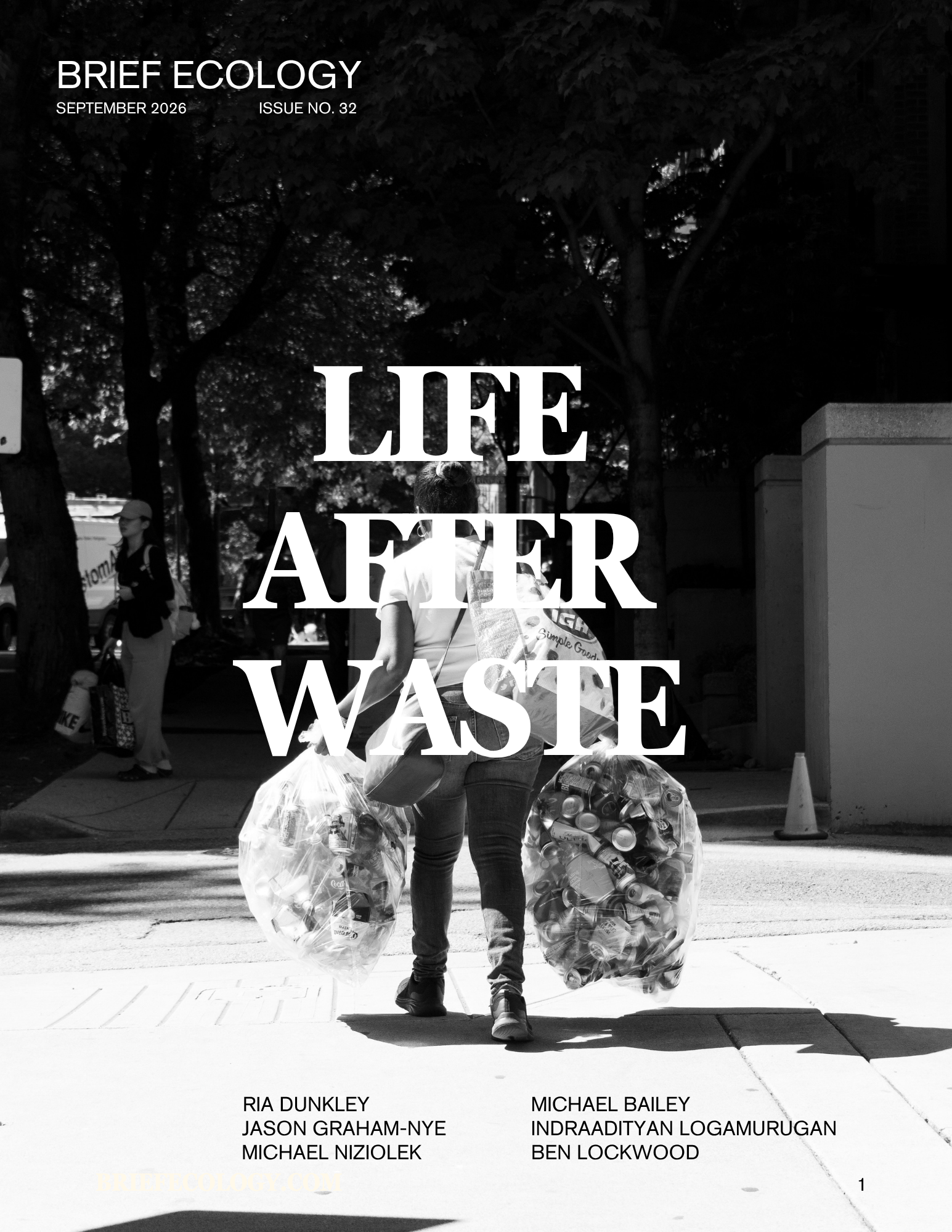
(ePub)
In This Issue
Non-fiction
Introduction: Life After Waste | Ben Lockwood
Beyond Clean-Ups | Professor Ria Dunkley
What it takes to give diapers a life after waste | Dr. Jason Graham-Nye
Notes From A Radical Ecologist | Interview with Conservationist Michael Niziolek
Eco Review | Space-Time-Nature-Gender Dialectics (or new from the old) in Joe Koch's Take Him
Fiction
The Rotting Leaf | Reclamation by Michael Bailey
Poetry
#TheRottingHaiku | by Kamen Nedev
Photography
Cover Photo | by Indraadityan Logamurugan