
Book Release | Workers and the World: Fighting Ecological Crisis from Within
by Lorenzo Feltrin
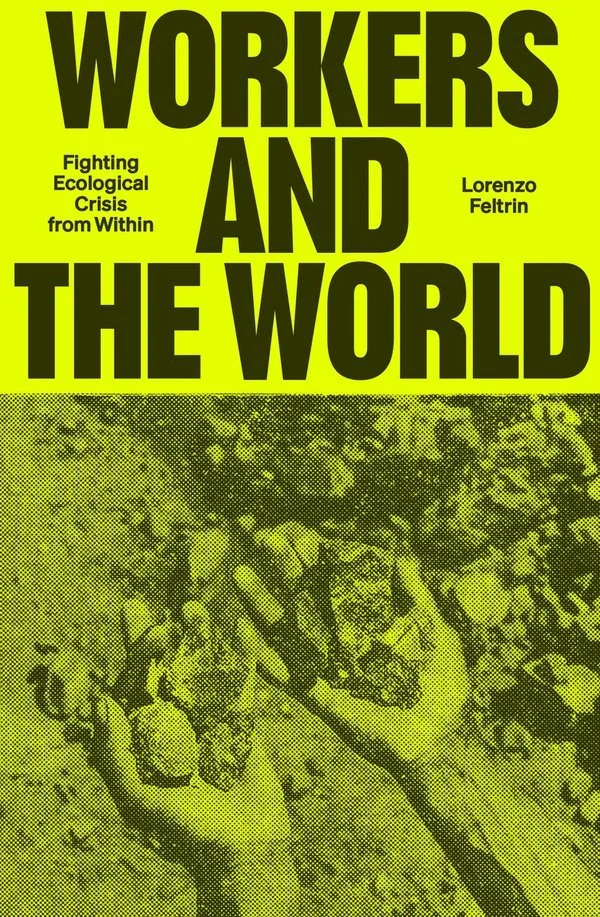
Cover of Workers and the World
In June 2026, Verso released my book Workers and the World: Fighting Ecological Crisis from Within. While agreeing with the eco-socialist argument that capital accumulation is inherently geared towards the parallel accumulation of environmental damage, this monograph shifts the focus from capital to the working class, to make sense of the latter’s contradictory place in the ecological crisis. Building on Marx, Italian philosopher Mario Tronti emphasised the dual nature of workers in capitalism as both an embodiment of capital (variable capital) and as a force antagonistic to it: ‘When we are talking about the working class within the system of capital, the same productive force really can be counted twice: one time as a force that produces capital and another time as a force that refuses to produce it; one time in capital, another time against capital’.[1] Workers and the World similarly argues that the working class in the ecological crisis really counts twice: one time as a force that produces the ecological crisis, and another time as a force that refuses to produce it; one time in the ecological crisis, another time against it.
We are in the ecological crisis, and not just as victims of an environmental devastation that is unequally distributed along intersecting hierarchies of class, race and gender on a global scale. We are part of the crisis because in our society we rely on capitalist work (our own or that of others) to pay for the things we need to survive. This means we also depend on the infinite growth of commodity production that defines capitalism and drives the ecological crisis. In particular, the reproduction of the working class as a class is tied to the reproduction of capital as a social relation, and vice versa. Nonetheless, workers’ insertion in capital accumulation also has an antagonistic face, rooted in their very separation from the means of production. For what concerns the ecological crisis, workers bear little responsibility for environmental degradation while being highly affected by it. Therefore, the working class is potentially a crucial collective actor needed to address the ecological crisis.
The relationship between workers and ecology has been studied by a rich and valuable set of literatures. Environmental justice studies have mainly focuses on community-centred disputes, while environmental labour studies (in their early version) have mostly brought to the fore workplace-centred organising. However, workplace-centred environmentalism is either limited to internal health and safety or idealistic (as it is not grounded in immediate material interests). On the other hand, the community is the domain in which workers experience a more direct interest in containing noxiousness external to the workplaces. Yet, community-centred environmentalism, on its own, lacks the structural power to change production from within. The limitations of both workplace-centred and community-centred working-class environmentalism when approached in isolation demand we consider the problem of convergence between workplaces and communities.
To explore these questions, Workers and the World starts from the New Left tradition of operaismo, or Italian workerism. In doing so, I have treated operaismo not as a complete and infallible doctrinal corpus. Very much like any other theoretical and political current, operaismo was a product of its context, in this case the workers’ struggles in the Fordist factories of Northen Italy in the 1960s. As I have grown up politically with this tradition, I rather take operaismo as a situated point of departure, from which to engage with perspectives coming from people and places variously distant from the Italian workplaces, communities and universities where operaismo originated. The book thus articulates classic operaismo with Marxist feminisms and Marxisms from the Global South, particularly dependency theory, to tackle the issue of labour and ecology.
Drawing on sustained and original empirical research into four case studies, two in the Global South – gas extraction in Tunisia and copper processing in Chile – and two in the Global North – petrochemical production in the UK and Italy –, Workers and the World discusses four topics in relation to the ecological crisis: automation and deindustrialisation, employment precarity, imperialism, and social reproduction. Along this journey, the book argues that noxious deindustrialisation – employment deindustrialisation combined with the persistence of industrial toxicity – has been one of the most salient manifestations of the capitalist form of noxiousness (production-induced harm against both human and non-human life) in recent decades. Noxious deindustrialisation contributed both to wearing away Fordist social contracts in the Global North and to renewing the expansion of the surplus working class, most severely in the Global South. These wreckful tendencies can, however, be countered by a working-class environmentalism, starting from workers’ reproductive interests in their communities as well as Global South workers’ interest in rejecting the incumbent international division of labour and noxiousness, and aspiring to become as widespread across the global working class as possible. The book thus offers insights on the possibilities for convergence between workplace and community mobilisations for alternatives to the jobs versus environment dilemma, against the ecological crisis.
[1] Mario Tronti, Workers and Capital, London: Verso, 2019 [1966], 401.
Lorenzo Feltrin is a researcher at Ca’ Foscari University of Venice. He grew up in Treviso, close to Venice and its industrial hub, Porto Marghera. In Treviso, he took part in the occupations that established the Django Social Centre. He is active in international social movement networks mobilising on labour and environmental issues, such as the Ex GKN Florence’s autoworkers struggle for a just transition.