
by James Parenti
To finally escape their father after they put him in the ground was the idea. That too-warm, too-bright spring day when the sun blanched the budding greens to near-white. After weeks of packing into boxes his books and photos, yes, even pictures of the two siblings as kids, wide-eyed in the Polaroid glare. After donating his boots, tools, and weights to charity. After staring, puzzled, at his shelves of greater and smaller pottery, shelved in the garage.
To finally escape the moldy shadows and smoke-filmed windows of the house their father left them, they fled to the woods behind the property, gone dusty and dry this time of year. A favorite place of his childhood which he spent weeks exploring. He so loved the forest, and a particular willow within it, that he’d etched into his arm a tattoo of the tree’s figure.
The sky, which when they were kids seemed always to be falling, shone an aggressive, masculine blue. Sweat beads streaked down Deb’s back like switch lashes. Danny was nearly disguised in his ballcap, sunglasses, and the beard he’d grown since the funeral. In a canvas bag over his shoulder tapped dryly together a collection of urns, vases, and abstract trees their father sculpted in his final years of solitude. To bury or smash or simply abandon them Deb wasn’t sure, but she didn’t question her brother’s solemn determination.
As the scrub turned to wood, a knee-high stump presented them a gift made of light, metal, and glass. Deb crouched to investigate. Wire-frame glasses, just as Dad had worn, half-grown from the stump, lodged in the tree’s dry meat. Pointing further into the forest as if directing the siblings’ attention deeper. One twisted earpiece reached up toward clouds blown gray-white in the sun’s brilliance. She and Danny gaped at each other, the torn metal, the stump, and the trees.
She ringed a knuckle around the glasses’ bridge and pulled. Refusing to dislodge from the wood, the metal wrenched, then snapped. The lens stared into her palm, its single wiry wing protruding between her fingers.
To Deb, shaken now and loath to venture further, this seemed a fitting spot to unload their father’s works. But Danny stood resolute and aimed his tread into the trees’ shadows, as the lenses had directed. She followed, pocketing the glasses.
Thickets sprouted, shaggy like Danny’s beard and the coarse hair itching under Deb’s arms. When their path paralleled a narrow creek, Danny stopped and stared long into its glassy blackness. Deb waited beside, watching him and the water, until some massive and barely submerged thing disturbed the stillness and vanished. Danny sucked in a long breath, stilling himself. In childhood, Deb encouraged his fear of the leathery nightmares in the swamp and sawgrass, a dread he still carried as an adult. He stretched his fingers wide, flexed them, and hiked on. They trekked beside the creek, at a distance safe yet close enough to keep sight of it. Long after the creature was gone, Deb sensed it in the mud still, vibrating as if burrowing under the earth.
Then, a sudden slipping step on damp ground pulled them into a patch of shade. Towering above, a willow, where before the horizon was interrupted only by rough pine. Shocked, Deb knew this tree. She knew. Its ink outline in her memory overlaid perfectly its slow-swaying form in life. A snare-drum roll or machine-gun rattle sounded the tree’s appearance. Ringed in gold, its rounded peak leant sidewards at an angle suggesting a forehead bowing, bullish and drunk.
Danny disappeared into the leafy dome, and, steeling herself as if to plunge into freezing water, Deb followed. Before the trunk, her brother knelt, arranging their father’s pottery. He weighed a piece in hand, placed it on the grass beside its siblings, then moved and replaced it, searching for some arrangement that might satisfy him. She watched, reverent and puzzled.
Again, the rifle sounded. They raised their heads and discovered at shoulder-height a woodpecker working, its beak darting, revealing the willow’s paler flesh beneath. The noise ricocheted down to them off the tree’s makeshift ceiling.
“Shut the hell up,” muttered Danny, intent on his work, flexing a palm into his temple. Like Dad, he’d never taken well to interruptions.
But again crack, sounded the drum, insisting, crack-cra-crack.
“Shut the hell up!” he snarled, and whipped a vase at the bird, missing it but shattering the ceramic. The collision left a crater in the bark where the bird had been.
And there, revealed by the woodpecker’s carving: a forearm. That same forearm they knew, tattooed with the same bark it grew from, ringed in dark curling hair. Tense tendons under unmoving skin. A dry wind rustled the leaves around them. The damp shade under the willow smelt now of sawdust, hops, and motor oil.
Danny froze in panic, staring in a way that felt eternal. He forced air through his congested nostrils like a bull, triceps tight to his armpits, shoulders churning with the effort of stillness. Finally, he launched a vase at the arm, then an urn, and another, an unending hail of ceramic that burst in shards and dust. Deb wrapped her arms around his chest to calm him, struggling against his bullish strength, but he stopped only when he had no more sculptures to weaponize. She held him til he fell to a knee, panting.
Never would Deb become accustomed to her little brother having grown bigger than her. Still, Danny would kneel there til he moldered if she let him. Being the firstborn, it was her job to protect him, and keep protecting him, no matter how many years they lived through. In the quiet following his outburst, seeing in the tree the familiar flesh now unveiled to the elbow, she stood. She could not allow this forest to stand, with all its wood-borne echoes and reminders.
She shook herself free from the willow’s embrace, marched back out into the light. The sun cut sharp on her cheeks. Retrieving the glasses lens in its torn frame from her pocket, she gauged the angle of light to a reedy branch, then focused and narrowed the beam, winnowing the sun to a tiny supernova on a particular leaf.
As the season was dry, the leaves accepted the heat, buckled, crumpled, and took light. Yellow flames eddied and raced up the tawny branches to the tree’s heart. The siblings watched as the willow welcomed the fire and ringed itself in a new gold, then passed its gift to its neighbors who, each in turn, threw their blazing arms in the air amid a shower of embers.
She looked with satisfaction on her creation. She willed the fire to spread, to swallow the woods and the house whole until there was nothing left, nothing left of him at all.
The heat gained in ferocity on their faces. To escape the burning forest now surrounding them, they ran. Under a cover of smoke that clouded the sunset purple they panted, gasped, and sweat. When a flame licked Deb’s sleeve, hungry to light and devour her, she dove into the creek. Turning back underneath, she saw Danny, smeared by orange reflections on the water’s surface. He hesitated, then leapt to join her.
The sky split its belly open and thundered down around them. The forest erupted in gusts of steam where rain met fire. Part of Deb knew it was the wrong time of year for such a heavy rain. Nevertheless, rising for breath she found the air almost as full of water as the stream, dousing the world in steady sheets. The river’s surface stretched itself wide and took the sky’s lashings in their stead. Their universe became a shudder of gray and brown light.
After the heat and fire, the water was cool, dark, and deeper than they expected. Any subaquatic nightmare, sensing them, abided their presence and allowed them now to pass.
Diving with full lungs, they swam the stream’s length back to the edge of the forest. They made land beside the stump, now hollow and sodden, and ran to their father’s property—their property, now. The house waited solid on its foundations, keeping watch where they’d left it.
Inside, their shoes slapped wet tracks on the dusty floor. They panted and dripped. Deb dropped against the wall, her brother slumping beside her. His face contracted, eyes all puckered and mouth pulled tight. He looked again like himself aged five or six, a small and sour boy, bracing for impact. She draped an arm behind his neck; he buried his head in her shoulder and slept immediately.
As the rain weakened its resolve, metallic drops pinged against the window.
The air pulsed, a thundering thrum that seemed to come from not the sky but the walls. She stiffened with alarm: did this empty house have a heartbeat? Around them, was it breathing? She held herself silent, waiting for the throb to come again. The foundation creaked as it settled. But no: everything left of their father was inert. She was free to rest now. They both were.
Danny’s fingers twitched in his sleep. The house embraced them, sheltered from the dying storm, the doused fire, and the coming night.
James Parenti (he/him) is a Pennsylvania-based author and playwright. His short fiction has been shortlisted for Uncharted Magazine’s Cinematic Story Award and published by The Rotting Leaf, Haven Spec and The Dread Machine. His plays have been produced in multiple theaters across the US. He lives outside Philadelphia with his spouse and two creepy kitties named after Gothic literary characters. Find him at @jamesparenti.bsky.social on Bluesky and @jamesdparenti on Instagram.
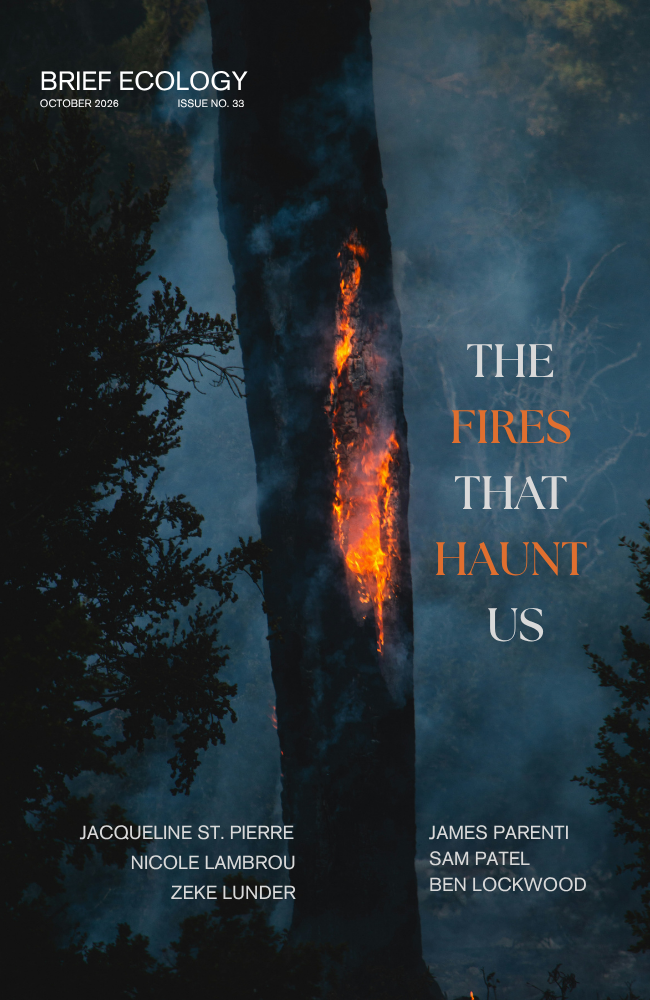
This short story is from The Fires That Haunt Us
🔵 EPUB | A standard e-book file you can read on any device🟢 DRM-FREE | Open & shareable booksIn This Issue
Nonfiction
Introduction: The Fires That Haunt Us | Ben Lockwood
We didn’t start the fire | Jacqueline St.Pierre
Who Returns To Paradise | Nicole Lambrou
An Interview with wildfire geographer Zeke Lunder
Eco Review: Red Flag Warning and the Mutual Aid Difference | Ben Lockwood
Fiction
Dry Season | James Parenti
Poetry
#TheRottingHaiku | Roblin Meeks
Photography
Cover Photo | Sam Patel