
Interview by Ben Lockwood
Zeke Lunder is a geographer and wildfire expert with over 30 years of experience. He runs the-lookout.org and several social media channels where he educates and informs the public on wildfire dynamics. Below is an interview about his work, the state of forests and fire in California, and the importance of geography to the wildfire problem.
Ben Lockwood: I recently came across your site, The Lookout, where you not only report and inform on current wildfires, but also educate the public on the science of wildfire. First, how did you get started doing this kind of work? How long have you been doing it and what drew you to it initially?
Zeke Lunder: We started The Lookout during the 2021 Dixie Fire, which burned almost a million acres near where I live now, and all around the town I grew up in, in Northeastern California. I started a blog about the fire, because I rarely see the mainstream media covering wildfire with any level of nuance, and we recognized a need for alternative sources of fire commentary and fire reporting. The blog grew into a YouTube channel, which is now our primary method of spreading our stories.
BL: What is the current state of wildfire and wildfire management in California? Are things improving?
ZL: It’s mixed! On the positive side, the State has taken a very active role in increasing the amount of fuels treatment around at-risk communities. They have also put a lot of funding into developing a non-agency prescribed fire workforce and passed a lot of legislation that makes it easier for civilians and private burn bosses to implement burns on private lands. A lot of our landscape has burned in the past decade, and like it or not, much of the work we need to do will be happening in complex, post-fire environments.
Across my career, the State has been loath to really enforce defensible space laws, and many of our communities have extreme wildfire hazards, both from outside of the urban area, and within. Insurance companies are probably the entities with the most sway over what is going to happen with [wildland-urban interface] fire mitigation. Lots of communities are losing their insurers, and this has very wide-ranging effects. But where insurance companies demand action, homeowners are very motivated to get it done.
On the flip side, the US Forest Service has actively been going backwards with their policies and achievements. As I am writing this, they are actively suppressing several small lightning fires in the mountains of NE California which ignited last night deep within large burn scars from our recent megafires. It is prescribed fire season, and these fires have potential to do a lot of good work in cleaning up dead and down materials within the burned areas.
Unfortunately, there are national policies in place for the Federal land management agencies, this year, which mandate full suppression of ALL wildfires. USFS prescribed burning achievements are also on the decline, and they remain burdened by regulation, and are losing a lot of experienced people. They have made it really hard for the people who want to get burning done to accomplish much of it.
BL: On your website you mention the importance of historical context and geographic specificity. As a fellow geographer myself, I find this critical. Can you expand a bit on what you mean by this context with respect to wildfire?
ZL: Across the country, our fire regimes, fire ecologies, settlement patterns, and histories with fire are incredibly varied. I think that many well-meaning people often take something interesting and ecologically relevant that they have learned about their local wildfire regimes and attempt to project this across the larger landscapes. There are things which are universal about fire, but often, the regional differences are very important. For example, in Southern California, there are valid concerns about the ecological impacts of fuels reduction or modifications in local chaparral habitats, but SoCal activists are applying their talking points to Northern California ecosystems, often in ways which obstruct vital burning or thinning work up here. Every place has its own unique wildfire issues, and we oversimplify them at our own peril.
Many of the places we work hold important lessons from past fires, and even the interactions of multiple rounds of fires or management impacts. For example, the severity patterns of many NorCal fires reflect past interactions between historic logging, regrowth, and subsequent fires. We like to use mapping, imagery, and GIS data to illuminate these stories and help people understand some of the cause and effect that becomes evident during modern-day wildfires.
BL: Are there things that you know now that you wished you’d known in the beginning of starting The Lookout? How has the work changed or evolved over time?
ZL: I wish I would have quit my day job (running a GIS/pre-fire planning consulting business) sooner! I started doing The Lookout fulltime in January of 2024, and it has been going well, and growing since then. Trying to hold down a fulltime job while parenting and running The Lookout was a grind. I wish I would have been more plugged into meteorology from the start. This has emerged as a critical part of our daily wildfire briefings.
BL: It seems like some of what you do overlaps with journalism and storytelling. Why do you think storytelling is so important? Is there a specific story or person that has stuck with you over your years of experience?
ZL: I have worked for the past 30 years in wildfire and wildfire-adjacent jobs. There is a strong storytelling culture in wildland fire, and magic happens when you put a map in front of someone who has great place-based stories. I’m lucky to have been around a lot of people who had interesting experiences to share, and to have been blessed with curiosity to listen for them or ask to hear them. I think that’s part of being a geographer - we are trained to seek out interesting angles, and to try to ‘put them on the map’.
A lot of the stories I think have been most impactful, for me, are the ones that help explain things I am seeing now, on the landscape. For example, my mentor, Barry Callenberger, told me, in great detail, about how, in 1999, he and Jim Klump got hired to conduct a 30,000-acre firing operation to contain a large fire in the Feather River Canyon. They had specific ecological outcomes in mind which drove the techniques and timing they used to choreograph a complex, week-long sequence of lighting those 50 square miles on fire (using helicopters and hand crews). Over the past 25 years, this entire landscape has re-burned, but many areas which were back-burned in 1999 have had less-severe fire effects than the surrounding areas. Every time I drive Highway 70, I can still see the effects on the landscape from how it was fired back then.
BL: Everyone in forestry has their own opinion on “the fire issue”, and why they’re getting worse. Based on what you’ve seen and studied, what’s actually going on in western forests?
ZL: It’s a mix of climate change, past logging, the sudden halt in logging on Federal lands in the late 1990s, and, of course, fire suppression. We’ve got way too many trees in a lot of places. Also, many areas which were covered with more hardwoods in the past have become dominated by conifers, largely due to fire suppression.
BL: What would you tell people who are interested in being on the fireline? Or working in wildfire management in general.
ZL: Fire is the best teacher. If you’re doing research on wildfire, but have no real firsthand experience with fire, you’re wasting your time, and also, the time of anybody who reads your work! There are lots of ways to get time around fire without having to get on a crew and eat dirt and ash for months on end, but there is no substitute for seeing fire in real life.
BL: Is there anything else that I didn’t ask about but that you’d like to share? Feel free to mention any books, resources, or other things you think are relevant or important.
ZL: Check out our YouTube page. There are a lot of great lessons burned deep in the second hour of our longer livestreams. We use ongoing fires to teach about the bigger picture of how fires operate. Don’t be afraid to dive into our longer videos, or to just randomly drop into minute 52:00 of a long video to see what we’re ranting about. I like to rant. That’s the good thing about being my own boss! youtube.com/c/thelookout1 www.the-lookout.org
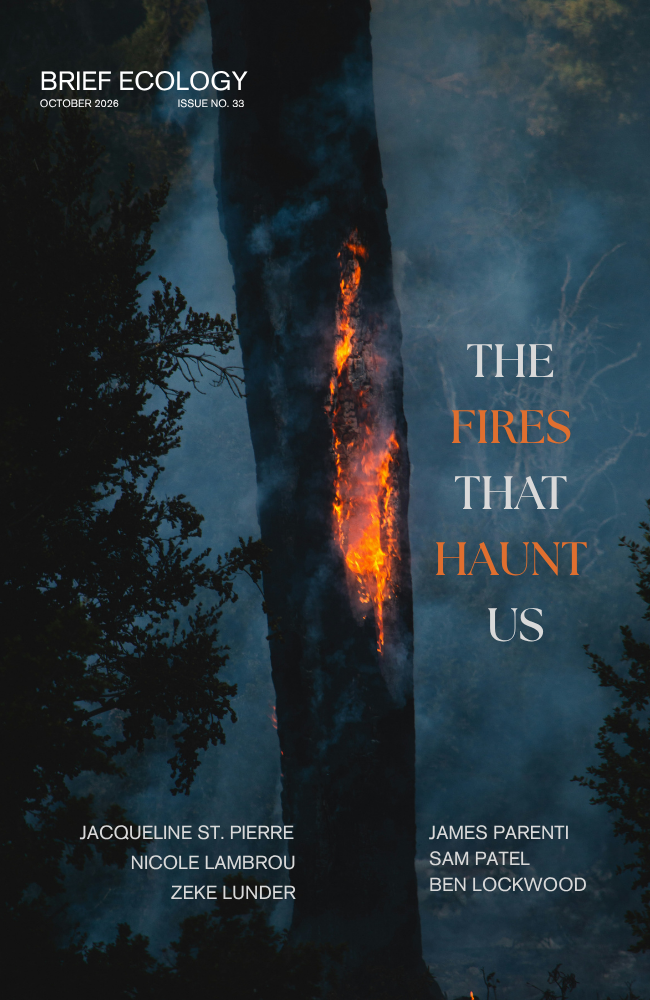
This article is part of our October 2026 book, The Fires That Haunt Us
EPUB – A standard e-book file that you can read on any device
In This Issue
Nonfiction
Introduction: The Fires That Haunt Us | Ben Lockwood
We didn’t start the fire | Jacqueline St.Pierre
Who Returns To Paradise | Nicole Lambrou
An Interview with wildfire geographer Zeke Lunder
Eco Review: Red Flag Warning and the Mutual Aid Difference | Ben Lockwood
Fiction
Dry Season | James Parenti
Poetry
#TheRottingHaiku | Roblin Meeks
Photography
Cover Photo | Sam Patel