
By Ben Lockwood
Since 2016, there has been at least 18 wildfires of over 100,000 hectares in North America. How big is 100,000 hectares? It's about 250,000 acres, or about 400 square miles. With nearly 2 of these per year, that means a forest fire roughly the size of the state of Rhode Island has burned every year for the past decade. Of course, some of these fires were much larger than 100,000 hectares, and there has also been many, many smaller ones.
In the midst of national attention on emergencies and the heroic firefighters, the actions of the communities that live in these burned places are rarely discussed. But it's how communities come together during these times-when traditional institutions break down-that can give us examples of new ways to organize society.
Red Flag Warning, from AK Press, is a collection of essays on the mutual aid and community work that arose during wildfires that have scorched California during the last decade. It's about the people and their commitment to both each other and the places in which they live.
One essay I found particularly insightful is Hiya Swanhuyser's Solidarity, Not Charity. The title reflects the slogan of the Mutual Aid Disaster Relief network, which Swanhuyser says helps communities heal after catastrophes.
What this essay makes clear is that community aid (or mutual aid) need not flow from the top down. Catastrophes like wildfire reveal that people in community, regardless of their wealth, can and do take care of one another. This is part of the mutual aid difference. It's not about the rich giving to the poor to boost their reputation or make catastrophes more manageable. It's about eliminating the need for the rich in the first place and making communities truly resilient to disasters the rich are ultimately responsible for.
Swanhuyser goes on to discuss the complex feelings around "disaster joy". It's a phenomenon that many experience in the aftermath of a disaster like catastrophic wildfire, when the community comes together in a way that it never has before. Old grievances are forgotten, new friendships forged, and there is often a newfound sense of shared humanity. It's not the disaster itself that creates these feelings of solidarity, but the community that rises to meet the new challenges, and in our increasingly alienated society, such disasters are often the first time many have felt such community bonding.
Another interesting piece in the collection covers role that incarcerated (formerly and current) firefighters play in fighting California wildfires. Dani Burlison interviews Brandon Smith, the co-founder of the Forestry and Fire Recruitment Program (FFRP). Smith confronted the many societal and structure barriers that incarcerated people face when trying to secure employment after their release.
Despite his experience as an inmate firefighter, he had considerable difficulty getting a job as an actual wildland firefighter once his sentence was complete. It seemed odd to Smith that, given the increasing need for firefighters amid larger and more intense wildfires, they would turn down people who had actual experience on the fireline.
Throughout the interview, Smith discusses how these experiences led to his co-founding the FFRP, and the difficulties they had getting it off the ground. Smith also talks about the FFRP's goal of getting more women and marginalized people into the wildland firefighting space. Wildfires are a community problem, and it should be the full community that participates in the solutions.
There's much more I could say about Red Flag Warning and the importance of mutual aid to strengthening communities in the face of climate change. The real insights are in the pages themselves, though. For anyone who is interested in alternative forms of community care, ones that don't rely on the same institutions that perpetuate the harms, this is a book to add to your shelf.
Ben Lockwood is a Geographer and Philosopher of Ecology. He holds a Ph.D. in Geography from Indiana University, and a M.Sc. and B.Sc. in Biology from Ball State University. Ben’s writing has been published in Nature, Clarkesworld Magazine, Area, Literary Geographies, and elsewhere. He is also the founding editor of Brief Ecology.
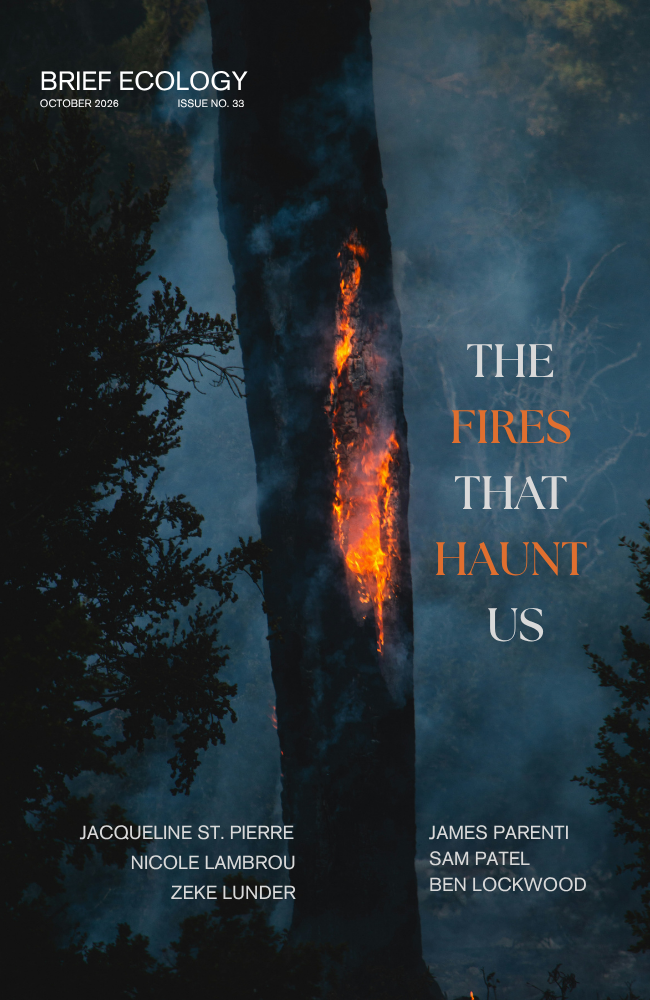
This article is from The Fires That Haunt Us
🔵 EPUB | A standard e-book file you can read on any device🟢 DRM-FREE | Open & shareable booksIn This Issue
Nonfiction
Introduction: The Fires That Haunt Us | Ben Lockwood
We didn’t start the fire | Jacqueline St.Pierre
Who Returns To Paradise | Nicole Lambrou
An Interview with wildfire geographer Zeke Lunder
Eco Review: Red Flag Warning and the Mutual Aid Difference | Ben Lockwood
Fiction
Dry Season | James Parenti
Poetry
#TheRottingHaiku | Roblin Meeks
Photography
Cover Photo | Sam Patel