
by Alexia Tiches
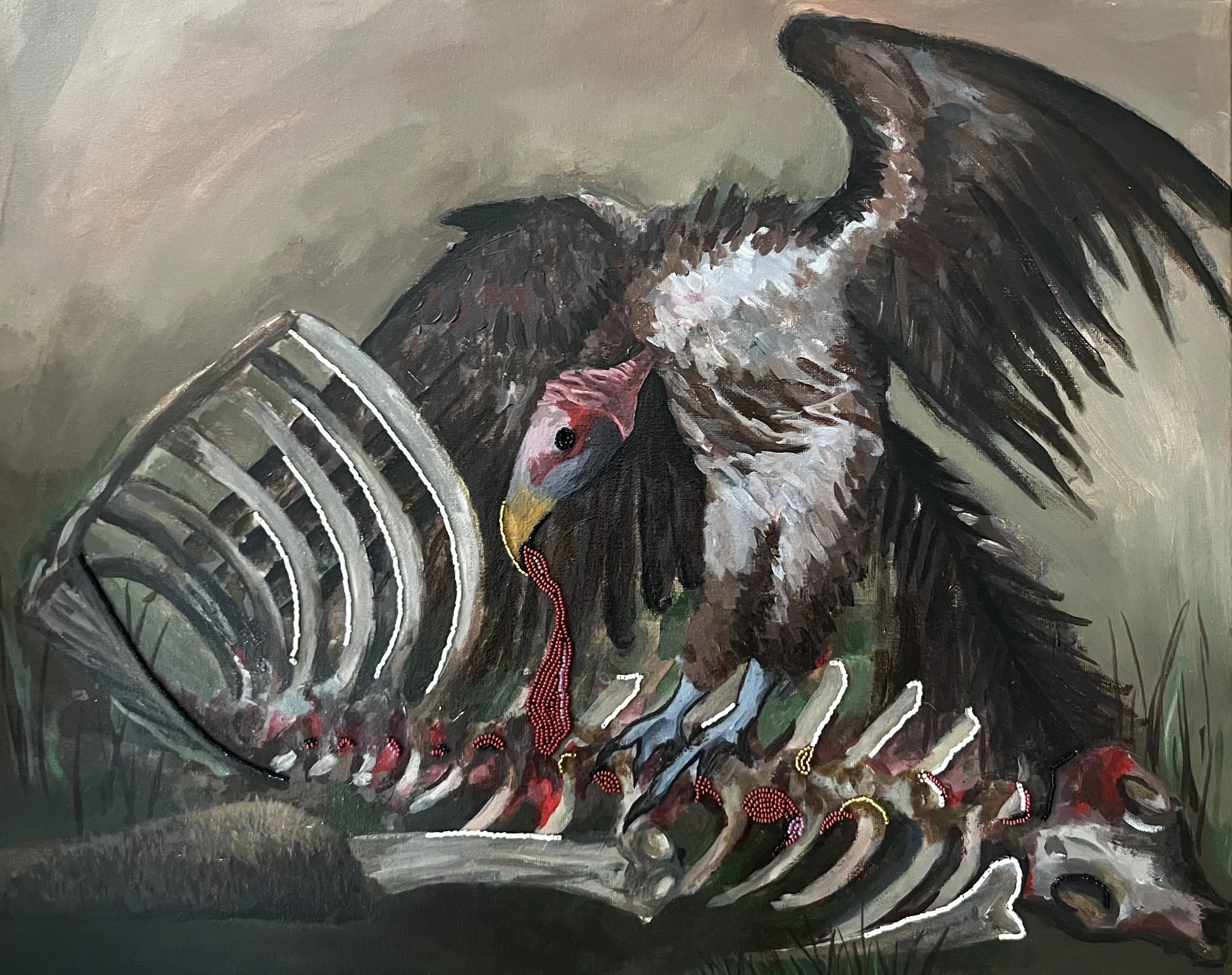
Artwork by Alexia Tiches
Vulture lounges in a nook of Broken Birch, his beady eyes lingering on Carcass below.
Thick muddy ooze leaks from organs ripped out of her stomach. Her foot lies melted from the rest of the form. Her brown curls, once shiny and soft, are now ragged whips matted to her decaying scalp.
All around Carcass, Field lies uninterested. It stretches far past the horizon, far past state lines and chipped blacktop roads and any municipal jurisdiction. Filled with native greens and weeds alike, vegetarians and carnivores, Field encompasses all who wish to live and die here.
Its indifference is as bold as it is encompassing.
No one will help Carcass. No one will come save her. She yearns to swaddle herself in her decomposing intestines, protection against the world, against Vulture, yet she can’t move.
Carcass is a carcass, after all.
Moments of the past bubble and pop with the gasses that escape her decomposition: a slumped birthday cake, a breath held for a wish, snowflakes on eyelashes, onions starting to brown on a broken stove, the freedom of wind on a country road, a byzantine chant echoing in the halls of an empty church, white flowers, black dresses.
They pass as vague meaningless images.
Blowfly is first to arrive—an oil-slick speck lapping her puddle eyes. Friends gather around her guts, laying their long milky eggs for future generations to feast. Fleshfly, Dipterafly, and Cheesefly kiss Carcass’s cracked lips. They slurp the salty remnants of tears along her cheeks.
She welcomes them with open, unmoving arms. She welcomes Rove Beetle and Hister Beetle, who quickly breach the surface, burrowing into tunnels of flesh. The flies unfurl their tongues. Scuttling seeds’ infinite sticky legs see their way around her clavicle, her armpits, feasting on her black kidneys, nibbling wet ribs that protrude from her chest.
When Carcass wasn’t a carcass, when she identified as something far more whimsical and lovelier, she passed Vulture many times in Broken Birch. She had seen him eye Magnolia with envy, their delicate flowers, and the green Hummingbird Fairy that flitted in a blink. Barely there, but indeed there. The stench of death follows Vulture always. He never paid Carcass attention then but waited patiently. He silently flexed his wings, showing his span, his cock, his domain. Father of death. Oppressor of the living.
Vulture thinks he’s everything.
Carcass wants to plead with him to spare her. Yet, she has no vocal cords, no muscles, no neurons to move her legs. The purple and green of her bruises shine bright in the afternoon sun, the remnants of her blood that once pumped. Her jaw decomposes from her mouth making her look perpetually in awe.
Vulture takes this as an invitation. He takes everything as an invitation. The insects continue their duties as he rasps and lands on her exposed rib. Sharp talons dig trenches into her skin. He nips at her rotted nipple, tearing a strip from her breast. Carcass watches the scavenger masticate her, sees her tit bob down his long-tangled neck on its way down to whatever depths of hell lie within her predator.
She cannot mourn it.
Tears are for the living. Grief and fear belong to bodies with autonomy.
At first, the flies don’t mind Vulture. Nature has its ways, brutal or otherwise, and no other species respects the laws like insects. They have no need for empathy or compassion when the meaning of life is munching rot and shitting out better rot. Yet, in consuming Carcass, they understand her fear, they taste the violation.
Acrid and sulfurous.
Carcass’s defilement turns her meat rancid and, even for the decomposers, she becomes too bitter to digest. Insects might not believe in altruism, but nothing can get between them and a tasty meal.
Under what skin that remains, Maggot, Blowfly, Beetle, Mite, their eggs, parents, cousins, lovers, frenemies, and neighbors all consolidate in her body. They round up her right foot, inching it back to her ankle. Tiny grubs travel up her limbs, replacing marrow with a core of creatures.
A spasm in the shoulder.
A twitch of the hips.
Vulture flutters a few feet from the ground and readjusts on a mossy log close by. His head angles out of curiosity. Never has a carcass fought back before.
Her new beetle-blood crooks her legs at strange angles, one after another. Billions of bugs prop up a tent that shouldn’t hold. Broken bones crunch as knees bends for her soles to meet the grass.
Pilopp Pa Crrrruuuck
Squeeerom Pleecooork.
Numb feet find their place in dead leaves, mushed rotten toes into Field. Her hips teeter and rock. Her torso is next. Shoulders slump to one side. Arms flop with the sudden movement. Together now, Carcass’s new life force heaves the bloated body vertically, her head bobbing back so fast her neck snaps back. Maggot inches their way through the esophagus, filling out the empty void, lifting her heavy melon to face the bird.
Hollow sockets meet hollow black eyes.
Carcass is just as surprised as her adversary, who crinkles his foreskin face with confusion and hatred.
“Who do you think you are,” cries Vulture, “to face death incarnate?”
Carcass doesn’t know who she is; she doesn’t remember. The days of identity are long gone.
Tender Blowfly pries her jaws apart to mimic speech, “I’m a carcass.”
Vulture lunges, hooked beak snapping at Carcass’s stomach wound, snatching a bit of rot and hocking it down. A dollop of dead flies flows from the wound and forms a small pile on the ground.
Carcass stumbles, but her insect friends catch her. So small and yet ever growing, the throngs of carrion creatures make her whole again. They tumble over each other and maneuver her limp limbs like a doll. They make her arms take a swing at Vulture. Carcass didn’t know she could defend herself.
Vulture raises his talons and rushes.
Maggot has never been angrier at this violence. Blowfly burns. Rove and Hister Beetle screech with primordial protectiveness. They sling Carcass’s arm and it tears free from the fleshy hinges that held it to her torso. The decomposers then wrap the bloated fingers around his neck.
And squeeze.
With silent understanding, the others swarm over themselves and scurry from Carcass’s body to her one hand, a black flood scuttling from her mouth, her ears, her ever widening stomach wound. They reinforce the hand with a new strength, the power of the many, until it forms a living noose slowly tightening around the beast’s neck. The rest of Carcass wobbles and collapses.
She watches darkened fingers grip tight around a neck that never thought it would end. Vulture thrashes. He gasps and rasps, sputtering some desire for mercy, some semblance of an apology, a screech for the opportunity to run free. However, bugs have no concept of mercy, and neither does Vulture for anyone but himself.
They do not let go.
Spittle spurts from his mouth. His wings try to swat away an enemy that was too small and too vast to fight. His talons claw in the dirt, tearing up Field, trying so desperately to maintain the weight of his losing consciousness.
A final crunch.
Silence.
His body goes still. Vulture’s wings crumple at his side. His cock lies limp on the grass. His beak, agape, will feast no more.
No one mourns him. There is no time. Grief is wasted energy for creatures that feed on death. Blowfly, Mite, Hister Beetle, Fleshfly, and loving little Maggot sigh with satisfaction as they swarm out of her hand and blanket the new carcass in an ocean of iridescent wings, legs, and pincers.
Vulture and Carcass slowly dissolve into insect. And when they’re finished eating, when their eggs have hatched, and their eggs have hatched, when all bones have turned from wet muck to ash to sweet soil, they will lean back and take a long-awaited nap.
Field understands their contentment best of all.
Before it was Field, it was Marsh, and once, long ago, it was Lake. Then the heat came and the greenery grew, the puddles giving way to sturdy thickened land. Throughout all its forms, its changes, countless bodies scattered and settled in its embrace. Other creatures ate and enjoyed the nectar of rot. They slumbered idly in the bones of the lost and dreamt that their children would do the same.
Those who knew it by those names are long gone and the memory of what it once was is outshined by what it is now. Yet Field remembers it all.
It remembers the laughter and faint shouts from across the way saying that it’s time for dinner and you better come in before it gets dark. It lets go of what Carcass once was, holding onto what she is now and offers space for what she will be, when she crumbles back into the grass, and the native sedges sink their teeth in the fertile soil.
It will watch all carry on.
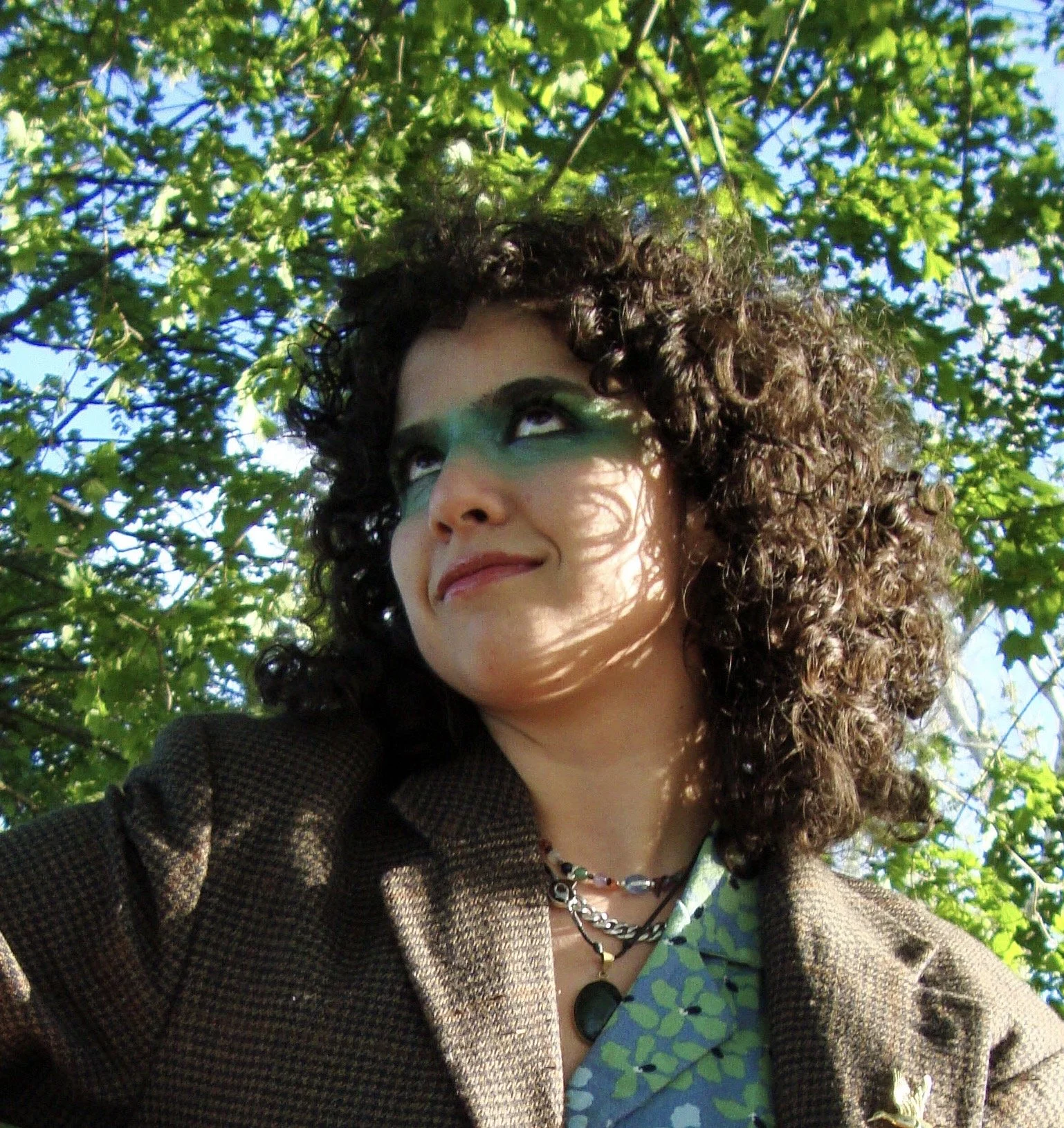
Alexia Tiches is a writer, visual artist, and performer currently based out of Chicago. Almost finished with an MA in Science Writing at Johns Hopkins University, her work focuses on the intersection of the existential dread created by modernity, the whimsy of nature, and the seemingly unfeeling oddities that come out of science. Her work has been featured in Off the Wall Plays and About Place. To enter her Amoeba-verse, you can read and see more at: amoebablah.com and on Instagram at @i_am_just_amoeba