Percentage, House
By Tabitha Soper
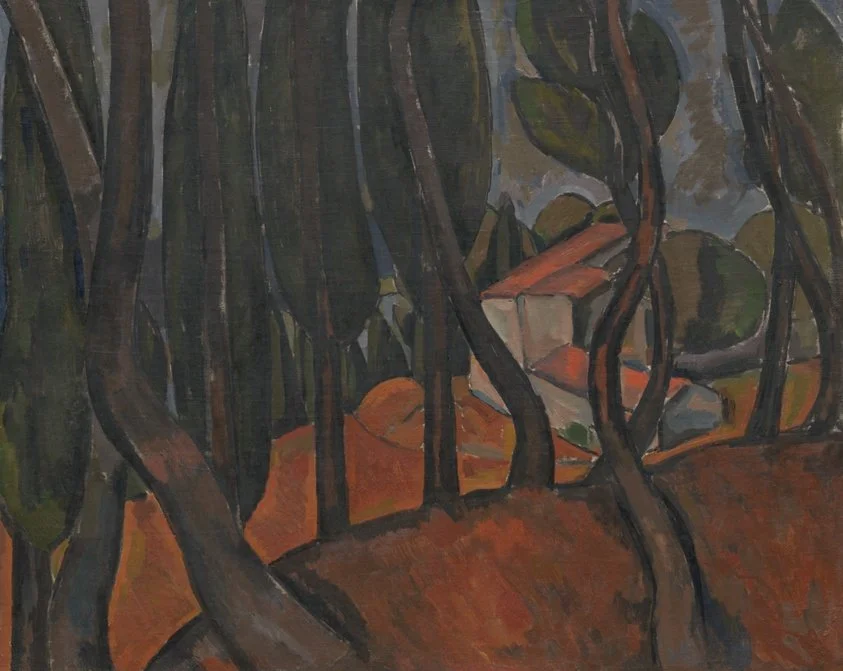
The first sign of growth was a lone shingle covered in pine needles on the forest floor. The man who’d found it had been with his son, walking the woods off trail, looking for crawlies beneath left-behind rotting logs. He’d told the local conservation department that it had been found by its lonesome in the center of a small clearing, that nothing but pine needles and fresh dirt had covered it, and that upon the removal of a superficial layer of soil, it did not budge.
That first shingle didn’t raise an alarm. The conservation department officer couldn’t wiggle it loose herself, and declared it an immovable piece of scrap that might come unfastened from the dirt after the next storm. She’d thanked the man and his son and sent them on their way, unimpressed by their findings. So unimpressed, that when the next two calls came in regarding the roofing in the forest, she didn’t so much as make the hike to the clearing. No one gave the growth the time of day until it had grown large enough to be significant.
The ridge had risen from the dirt as a long spinal column of perfectly laid tiling. It was approximately thirty feet and perfectly straight, newly triangular in shape. Preliminary digging revealed little more than a few continuing inches of gravelly shingle, followed by the twisted roots, presumably of nearby trees, that seemed to have fused themselves to the black tiling.
By then, the conservationists were not the only interested party. Local law enforcement got entangled quickly, wanting to find and question the culprit of the strange exhibition–there was no other word for it by this point. The conservationists argued that this was an aggressive form of littering, while law enforcement saw it as an act of rebellion; against what, they weren’t sure yet.
Police lined the crime scene with caution tape, and a post was released to the town for citizens to be on the lookout for anyone arousing suspicion, buying large quantities of roofing supplies. No such calls to action raised any verifiable leads. Concerned neighbors called in about neighborhood troublemakers, some more than a little racially charged, but not one call led anywhere. There was no decisive proof that any one person was in the act of slowly building a roof in the woods.
The roof did grow taller, though at first not by a measurable size. The movement was at first credited to the conservationists, who had tried and failed to dig around the structure and remove it. They dug until they reached the roots, however, in the interest of the surrounding wildlife, they refused to destroy the roots that had melded to the shingles. So, they failed to remove the structure from the clearing, and the project went disregarded for half-a-week while the conservationists decided how to proceed.
In those days of rest, the growth continued at a rate now quantifiable and conspicuous. It was no longer the possible doing of a local, but instead a living, expanding thing that sprouted uninvited into the local forest. By now, the roof clearly befitted a home, a home with yellow siding and white window panes, evidenced by the half of an oblong window that now spurted from the dirt. The roof, now somewhat house, was approximately five feet out of the ground.
This was around the time that some of those who had been working diligently on the project chose to abandon it. State and local government employees requested reassignment or quit altogether. Volunteers became the bulk of the crew with a scarce leadership party at the helm. At the behest of the environmental faction of the force, no additional digging was to take place. From that point onward, the project became solely stationed in survey, analysis.
Perhaps, if they had not been so focused on the divvying up of responsibility and aversion to the destruction of the house, they may have noticed the second one as it sprouted. Or the third. Or fourth. But they did not, not until the aforementioned spread had garnered their own heights, increasing to hip-height by the time they were noticed. By then, the original undesirable growth had fattened, growing by the foot, though it was never captured on the trail-cams provided by the conservationist department.
The first home was shaping up to be an average, suburban, middle-class family home. When the ledge of each roof finally burst through the earth, more windows could be seen following, poking out of the dirt like raised eyebrows. The windows were fashioned with impeccably white shutters, and inside, it seemed the home grew and transposed itself. In short time, officials recommended to the volunteers that they keep a distance from the windows. The suggestion implied safety concerns, but the truth was that everyone was scared.
The other homes continued to emerge from their plots, and volunteer numbers fluctuated. Some religious members deserted the program, fearing they had stumbled upon something beyond the means of God. Others flocked to it under the guise of religious intrigue and eagerness for involvement, quick to lay eyes on the newly restricted area and fall to their knees in prayer, some even accusing leaders and locals of witchcraft or trickery. Reporters even snuck their way inside, spending only enough time to draft an account or allegation, some claiming the homes were the work of a vigilante artist commenting on the subsistence of McMansion’s in New England suburbia while others opened their minds to the possibility that the growth of homes were an unforgiving act of nature.
As the phenomena generated headlines and garnered the attention of larger government bodies, there came a rush to put a gag order on the development of information. State federal bureaus sent agents to oversee groundwork and hold a perimeter on the woods, prohibiting unauthorized individuals from trampling evidence in what was turning into a modge podge of a crime scene and field station. All legitimized participants were required to sign NDA’s.
The Alpha case, otherwise known as Home A, was the first to cease growing externally. The foundation of the home was the final stem of the growth, and finally an entire home was made in the forest. Its yellow paneling was pristine, its windows perfectly rectangular and crystal clear. The home had a small farmers porch and a set of stairs leading to its front door, a set of stairs that all authorized personnel were forbidden to climb.
The following homes that sprouted in its wake were not identical in structure, though resemblance would be seen through the margin of growth. Each exhibited a different siding color, a different blueprint, and yet maintained a similarity in architectural style. Each home, to the alarm of their observers, did appear to continue fluctuating internally. Through the windows they were not to exceed a five foot distance from, walls looked to be erecting, crawling toward popcorn ceilings and integrating into one another, forging the confines of a real, inhabitable home.
The more the homes, the neighborhood garden, became livable, the more the researchers wondered why they could not be considered as such. There was unrest among the group, peaking when the final home, after its growth had seemed to have ceased, sprouted a chimney, which promptly began to billow with white smoke. The upset, however, quieted, drew inward to a discerning, compounded silence, when furniture bloomed from within each home.
As unnatural as the homes were, there was something more sinisterly artificial about the furniture as a sudden variable. This felt, moreso, like the presence of something other and yet familiar, something that came from man. This was, for many, the coup de grace. Leadership broke down and the chain of command was fragmented. The bureau had decided against signing on any new blood, and numbers dwindled. People left their stable, government agency jobs, scientists took up experimental religions, and when one enforcement agent was found dead, the project followed suit.
The nearby town was evacuated, gating off the phenomena as if the area was infested with radiation. And that was the excuse. They ran with the conclusion that the town’s water supply was contaminated from a local facility, and that the radius blockaded was uninhabitable for the foreseeable future, so dangerous that even those less vulnerable to the radiation were not to enter the premises.
However, if you were to peer inside the windows of the homes, now spread into a mass of sidewalks, gardens, and even mailboxes, you would find another life beginning in these woods. The shadows are difficult at first, to see and make sense of, but once you do, you’ll understand what you have witnessed. They don’t appear to sleep, but they do appear to dance, to laugh, to know one another even across households. It is in your best interest not to let them spot you. Despite appearances, you are not the same.

Tabitha Soper is a writer from north shore Massachusetts and an MFA graduate with the University of New Hampshire. Her work has appeared on Creepy podcast, and is forthcoming in an anthology with Cosmic Horror Monthly. She can be found at @tabithasoper_ on instagram.