
The Hut Upon the Sands
by Jared Oliver Adams
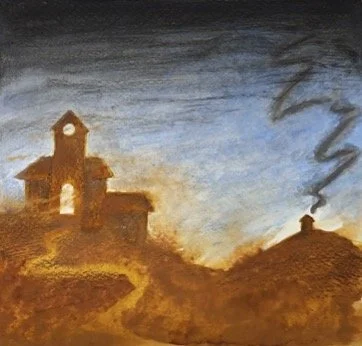
Painting by Jared Oliver Adams
The crossroads of souls shifts with the sands, so that each spirit faces a different dunescape when they drift from the tunnel.
Ages ago (aye, ages), Martin were the only solid person there at the mouth of the tunnel. The wattle of his domed hut was hope, the daub, pain, yet its chimney ever puffed a welcoming smoke into the chilly howl. On the porch, wrapped ‘gainst that gale, sat Martin hisself, sand gathering in piles at the large wooden wheels of his chair.
Most souls (he told me) were surprised when they drew close enough to see Martin’s crooked frame, spine bent painfully leftward, one hand flexed claw-like at his breast, the other spasming as it waved. His smile were a jittery thing as well, but sincere.
Some recoiled, but most bent their necks to follow him through the low door.
All spirits come through the tunnel naked and hungry, and Martin kept a pot of sweet cardamum rice warming on the hearth alongside the tea. Clothes waited too, rough and stitched all jagged, but always sized right, because, see, the wind itself would tell Martin who was about to come through.
After his guests were warm and fed (and never a rush at that), they had gained enough form to don the clothing. Then it was that Martin would gesture to the table, where was laid a board containing all the letters from all the languages of the world (every single one). Martin would stretch out his misshapen hand to point at one letter at a time: “T-h-e-r-e-I-s-L-i-f-e-B-e-y-o-n-d-T-h-e-S-a-n-d-s-.” And: “I-C-a-n-S-h-o-w-Y-o-u-T-h-e-W-a-y.”
Some took his offer, and, with the help of the wind, he charted for them a way through the sandy paths beyond. Others bid him farewell and (aye, fools they) made their own way.
But, one morning (if morning and evening exist in that place, which ain’t so), Martin rolled onto his porch to read the winds, and spied another solid person across the way. The man was surpassing beautiful, straight spine and strong arms. Martin called out to him with a strangled screech (to be true, his only sound) , but the beautiful man pretended not to hear as he hewed rock from the tunnel and formed it into a grand house. The stained-glass windows of the house, he hammered from longing, and the rich red door was hung with hinges of contentment.
When the beautiful man had finished building, he too sat upon his porch. And when spirits came, his mighty voice shouted welcome.
Who would you go to, emerging naked and confused into an alien desert? The elegant mansion, or the hut? The beautiful man who sprinted over to take your elbow, who, indeed, gave substance to that elbow with his very touch? Or the cripple who couldn’t even wave proper?
Passing few, indeed, were those who chose Martin.
And as more spirits came, the beautiful man added to his house, because, see, he didn’t ferry the spirits on, but rather lavished them with attention, which he promised for ever and always.
Martin’s plainly-sewn clothes piled up. His rice went uneaten, his tea undrank.
“What shall I do?” he asked the wind (for the wind, it understands strangled screeches).
“Observe,” the wind said back.
And so it be that Martin watched the beautiful man, from time to time, disappear into the tunnel with a spirit, then return alone.
Martin wondered if maybe they were being sent back to the living. A rare thing, that, but sometimes (says he) a thing the wind pointed him toward.
Curious, he wheeled his slow way to the tunnel and hid in a nook until patience paid its due. “Have I not given you of my abundance?” the beautiful man asked a spirit companion as they stepped into the nearby dark.
And this is where I come into the story, for I was that companion. “Aye,” I answered. “And grateful I am at that.”
The master of the house, the beautiful man that is, was leaning on me, tired-like, and I considered it great honor to hold him up, and greater still to go alone with him so he could tell me (aye, me!) of the tunnel’s mysteries. Then, he lunged.
It were a strange thing. Hardly any light, and so fast, and so unexpected.
Hard to reckon, even as it happened.
But he . . . he stretched his mouth snake-like and, with a massive bite, sunk his perfect teeth into the flesh of my shoulder. Then, splaying one hand ‘cross my face and pressing the other ‘gainst my ribs, he yanked back his head. My muscles stretched, then snapped, all-wet-like, as he ripped my arm off entire. I clutched the ragged wound and howled. The tunnel seemed to spin ‘round me, and at the center of the spinning was the beautiful man, using both hands to shove my arm down his gullet, his throat expanding hugely as he forced the meat of my upper arm through his jaws. Pain roared in the cave of my mind and skewered me to the spot, yet still (still!) I could nae believe what I saw. He seemed to know it too, because his eyes locked onto mine like he was daring me to object, even as he twisted the arm to fit the bend of the elbow into his mouth, even as he shoved it down his throat up to the wrist so the fingers grasped the air in front of his smiling lips. Gulping and choking sounds echoed in the darkness.
Then, out of the shadows, came a strangled screech, and there was Martin, ramming the man ‘gainst the wall with his wheeled chair. My shock broke like a spell, and I fled (coward, me) as the sound of struggle thrashed behind me. Indeed, I staggered to the only other building in the sands, Martin’s hut. And it was there on his porch that I hunched, trembling, eyes on the tunnel’s maw, waiting to see who would emerge.
Fear gripped me when I saw the beautiful man limp out, but he did nae turn to me as he shuffled back to his grand house (the light inviting through the stained-glass windows). I had just steeled myself to collect Martin’s body, when he came bruised and bleeding from the tunnel hisself, his chair battered.
I rushed to help him, but sparse help it was. Spirits don’t bleed like solid folk, but the pain were still a sharp thing, and you can see my arm ain’t never grown back. But we did push through the sand to his hut, and once there, he brought me through that low door of his as he had countless others. When I was warmed and fed, he led me over to his table to point at letters one at a time: “W-i-l-l-Y-o-u-G-o-B-a-c-k-A-n-d-W-a-r-n-T-h-e-m-?”
And when I said I didn’t understand, he told me all about the times before. It be a slow thing, that telling, but my recovery were slow too, from the arm and the beautiful man’s lies both.
And this is why I sit before you now, all rough-stitched clothes, and tell you plain: when death comes for you, (and aye, you know ‘twill come!) and you drift out that tunnel to the cold sand whipping ‘gainst you face, choose the hut.
For comfortable though that mansion may be, there across from the poverty of the hut, ‘tis an end. And that be one thing those dunes are not meant for.
Because, as Martin says: “T-h-e-r-e-I-s-L-i-f-e-B-e-y-o-n-d-T-h-e-S-a-n-d-s-.”
And, again: “I-C-a-n-S-h-o-w-Y-o-u-T-h-e-W-a-y-.”
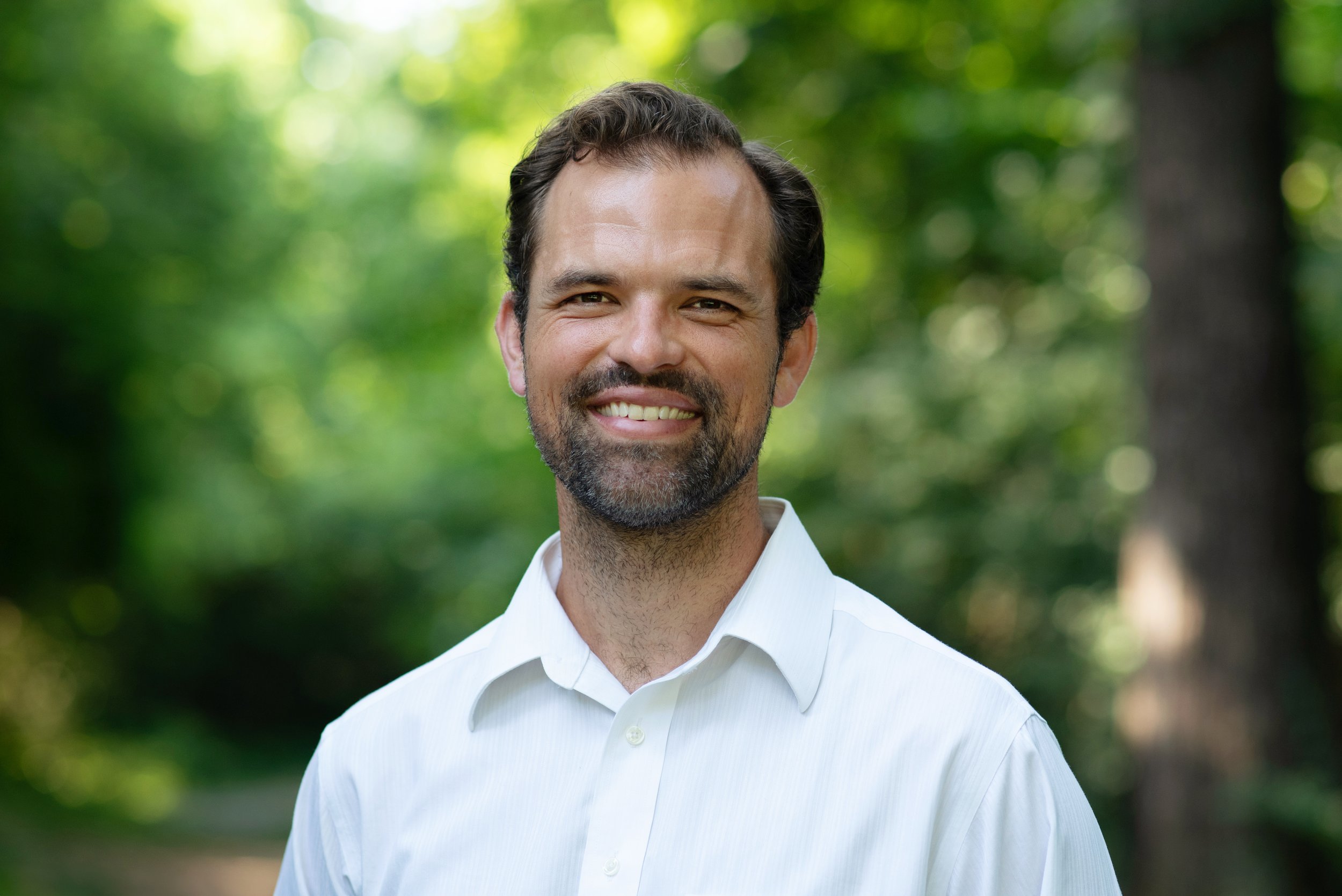
Jared Oliver Adams lives in Knoxville, Tennessee, where he writes, explores, and dabbles in things better left alone. He holds two degrees in music performance, a third degree in elementary education, and is utterly incapable of passing a doorway without checking to see if it leads to Narnia.