
Can Worker Co-ops Deliver a Democratic Ecosocialism?
A review of Worker Cooperatives and Deep Democracy: Transformative Politics and Planetary Care from Below from Pluto Press
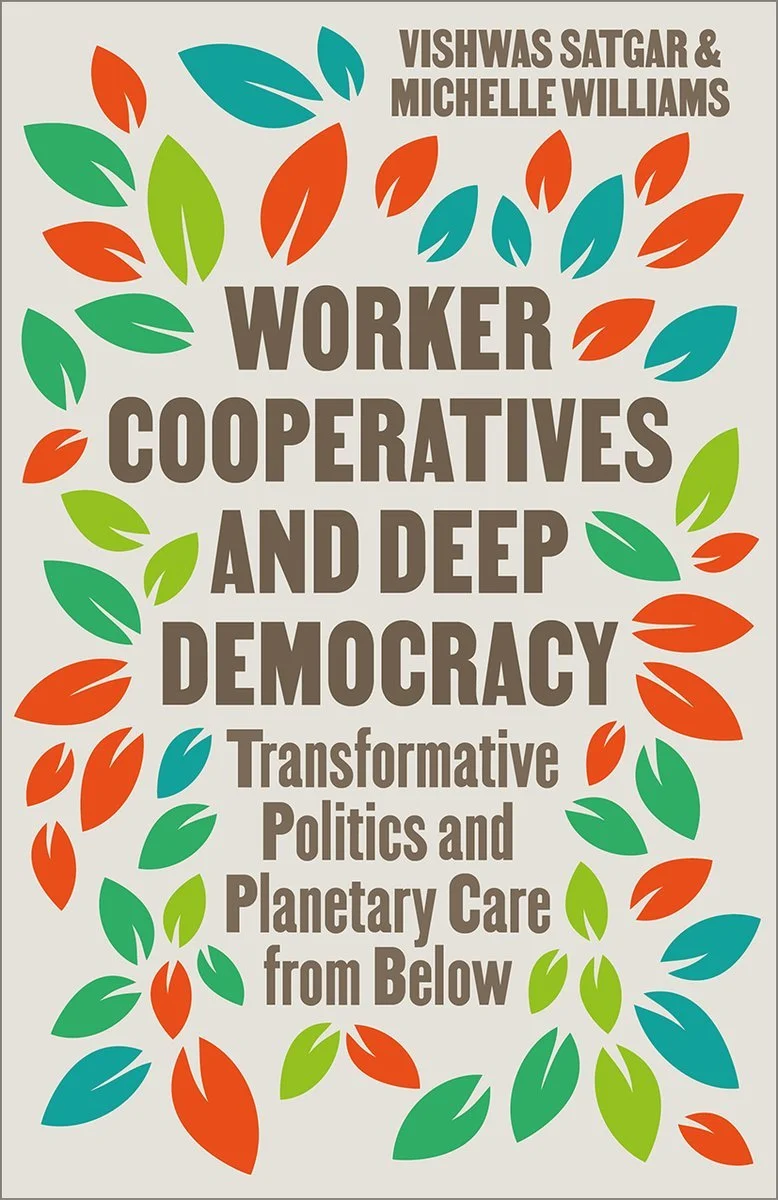
In their recent book, Worker Cooperatives and Deep Democracy, Vishwas Satgar and Michelle Williams argue that democratic worker co-ops have a key role to play in an ecosocialist future. Published by Pluto Press, the book explores the theory, practice, and necessity of organizing economic production around societal and planetary care rather than profit. In doing so, Satgar and Williams provide a powerful and inspirational look into some of the tools we can use to exit the destructive logic of capitalism.
Worker Cooperatives and Deep Democracy opens by characterizing what the authors call the “The Planetary Polycrisis”. Global capitalism is creating a socio-ecological rift, severing society from nature and putting civilization itself at risk. Planetary care labor is rendered invisible by capitalism, even as the system of capitalism relies on it for its own existence. This crisis is a polycrisis that manifests in multiple ways: inequality, poverty, disease, climate change, and ecosystem collapse. What we are witnessing, Satgar and Williams argue, is “the last great dispossession of the commons” by global capitalism.
This idea of the commons is actually central to the book’s premise. Society relies on forests, lakes, oceans, rivers, ecosystems, seed sharing, public infrastructure, knowledge systems, cyber platforms, cultural practices, and solidarity in order to exist. These are all part of our shared commons. The authors summarize this well, writing that “We are socio-ecological beings who are part of a rich, complex, and fragile web of life; we live in and are part of systems. This is one of the fundamental insights of the life-centric ontology of the commons.”
More from Brief Ecology

They also emphasize that despite the hegemony of global capitalism, the commons have not yet been completely consumed, and, even more promisingly, there is much work being done to prevent and reverse destruction. Transformative, democratic worker cooperatives function as a type of planetary care that can repair socio-ecological relations and bring us closer to an ecosocialist future. The book goes on to highlight a wide variety of worker cooperatives and solidarity economy networks from across the globe.
The first set of cooperative organizations the authors highlight are examples that integrate more balanced socio-ecological relations into their operations. These include worker cooperatives and solidarity economy networks in India, Argentina, and Brazil. It’s beyond the scope of this review to adequately summarize these examples, but their production ranges from infrastructure construction, factory printing, and manufacturing. Each cooperative arose out of its own contextual conditions and history (as do all), but what they share are commitments to democratic self-management, solidarity and care for worker members, producing goods that benefit society, and good relations with the natural environment.
Likewise, the second set of examples build on this ethos of planetary care by actually recalibrating their nature-society relations. Cooperatives in Venezuela, South Africa, and Italy acknowledge that nature is integral to their own activity and human life. In doing so, they break down the nature-society duality and steward the natural commons of land, water, biodiversity, creative labor, renewable energy and the broader earth system at large.
The book goes into far greater detail than can be covered here. For that reason alone it’s worth reading, but Worker Cooperatives and Deep Democracy does more than that. It goes beyond a simple-how to for worker transformative worker co-ops, in part because a specific blueprint is impossible. But more so, what’s here is both theory and practice, showing that it’s not only possible to produce what we need without capitalism, many people are already doing it. This book is full of experiments that provide alternatives to capitalism, and these are exactly the kind of experiments we need to exit capitalism into a better future.